
Vital Signs
AI Drug Discovery, September 2026: the bench became the bottleneck
Most coverage of AI drug discovery assumes the models are the hard part, and this month took that apart. Anthropic's general-purpose systems, with no biology model in the loop, designed working binders at two to three times the rate specialists publish as their own, and Bristol Myers Squibb bought design capability twice in sixteen days without disclosing what it paid. What none of it could do was establish which designs were good. That took a laboratory: the first blinded test of these methods had to physically build all 511 submissions from 29 organisations before it could report, and still found no approach that won across every task. The capital has read the same signal, and the cycle's largest European round went to Adaptyv Bio in Lausanne, which tests other people's designs for the model builders and for Roche and Novo Nordisk alike. The regulator arrives at the same place from the other direction, in a guideline in force since 23 July that asks six questions about any model, every one of them answered with an experiment.

The constraint in AI-enabled drug discovery is shifting from designing a molecule to finding out whether the design was right. Design capability is now purchasable and improving quickly, including from general-purpose models with no biology-specific training. Experimental validation is not: it remains physical, slow, and the only thing that can rank one computational method against another, which is why it is where capital, benchmark authority and regulatory evidence all now concentrate.
About this publication
This is the premiere issue of Vital Signs: AI Drug Discovery.
Every month it covers what is moving in target discovery, generative chemistry, and pharma partnering: the deals pharma is signing, the evidence that the methods work, the money funding them, and the rules governing how any of it reaches a regulator. The field is global and the coverage follows it, wherever the work is happening.
This edition covers 4 August to 2 September 2026 in four movements: design, the bench, money, and the rules. Most coverage of this field assumes the models are the hard part, and this month took that apart. Design capability turned out to be purchasable, and improving fast enough that a general-purpose model beat the specialists on their own measure. What none of it could settle was which designs were good, and settling that still takes a laboratory, which is where the cycle's largest European round went and where the regulator's questions now point.
Executive summary
| Priority | Signal | Action required |
|---|---|---|
| ACT NOW | ICH M15 has been in force since 23 July and names AI and machine learning models in scope | Read it against your own model documentation now, because the alternative is finding the gap during a submission review |
| ACT NOW | A general-purpose model reached hit rates two to three times the stated industry norm on targets it was never trained for | Reprice what you pay a specialist design vendor for, because the differentiated part may have moved |
| MONITOR | 511 submissions from 29 organisations produced designs that beat the laboratory and no method that won across all three tasks | Name the task your method won and say which one it does not do, before a buyer finds the second answer first |
| MONITOR | Adaptyv Bio raised US$40 million for wet-lab throughput and counts Chai Discovery, Roche and Novo Nordisk among its customers | Model your own validation capacity as a constraint with a price, not as a line item |
| MONITOR | Insilico reported US$103.1 million of half-year revenue from discovery and pipeline work against US$2.70 million from software | Check which of those two revenue lines your own plan assumes before your next board meeting |
Design
Anthropic's general models designed binders at three times the field's hit rate
A minibinder is a small protein built to stick to one chosen target and nothing else. The measure that matters is the hit rate, meaning the share of designs that actually bind when somebody makes them and tests them, and the honest number in this field has been low.
On 18 August Anthropic reported that two of its general-purpose models designed minibinders against fifteen targets with no specialised biology model in the loop. Of 1,320 designs, 354 were confirmed to bind, covering fourteen of the fifteen targets, at hit rates the company puts between 22.6 and 35.1 per cent against a stated industry norm of 10 to 15 per cent. Against one target the rate reached 40 per cent where human participants managed 3.7. Against maltose-binding protein, none of ninety designs bound anything at all.
The same pattern shows in the month's strongest single design. Aureka Biotechnologies produced an antibody reaching 94.7 picomolar, roughly two thousand times stronger than the one it started from. Picomolar is a thousandfold tighter than nanomolar, and tighter binding is what a therapeutic antibody needs. The experimental control it beat took three months of phage display maturation, the standard laboratory method of evolving a binder through successive rounds of selection. The designed version took under a week.
Bristol Myers Squibb bought design models twice in sixteen days
Four pharmaceutical companies bought access to somebody else's models this cycle, and none of the agreements carries a disclosed number.
| Announced | Platform | Buyer | What was bought | Terms |
|---|---|---|---|---|
| 5 August | Schrödinger | Bristol Myers Squibb | Bunsen agentic AI co-scientist, computational chemistry stack, RetroSynth planning | None disclosed |
| 20 August | Chai Discovery | Bristol Myers Squibb | Molecular folding and de novo design models across the discovery portfolio | None disclosed |
| 4 August | Phylo | Chugai Pharmaceutical | Biomni Lab agentic platform, connected to Chugai's own research data | None disclosed |
| 28 July | Phylo | Ono Pharmaceutical | Biomni Lab for Ono's discovery scientists | None disclosed |
| 10 August | Amazon Web Services | Novo Nordisk | Preferred cloud and strategic AI partner, London co-innovation hub | None disclosed |
| 6 August | Evotec | Odyssey Therapeutics | Screening, compound libraries and AI-enabled data science | Milestones only, no amounts |
Set that against the older shape of a discovery deal, where a platform designs a molecule and takes contingent milestone payments the industry calls biobucks. Relation Therapeutics and GSK announced one on 30 July worth up to US$110 million. Aqemia and Sanofi have run another since 2023 worth up to US$140 million. Both predate this window, and both carry a number.
Sources: Anthropic, 18 August 2026, a company research report that has not been peer reviewed. Schrödinger, 5 August; Chai Discovery, 20 August; Phylo, 4 August and 28 July; Novo Nordisk, 10 August; Evotec, 6 August; Relation Therapeutics, 30 July; Aqemia, 22 July. Every deal here was announced by the platform side, and three of the six carry no separate confirmation from the pharmaceutical counterparty.
Applies to you if: you buy or sell molecular design capability, or your plan assumes design is the differentiated part.
The bench
Twenty-nine organisations submitted 511 antibodies and a laboratory had to build every one
Almost every claim made for AI in molecular design until now has been retrospective. A model is shown data it has never seen, and its predictions are scored against answers that already exist. A prospective benchmark inverts that: participants submit designs before anyone knows the answer, the organisers build them in a laboratory, and everyone finds out together.
Nature Biotechnology published the first one for antibodies on 19 August. AIntibody, organised by Specifica, an IQVIA business, took 511 submissions from 29 organisations across three tasks: improving the binding strength of antibodies drawn from an early sequencing output, ranking candidates within a structurally related cluster, and designing binding regions for proteins absent from any selection output.
The part that took the time is the part that gives the result its authority. Every submission was made as a full-length antibody and measured under standard conditions by surface plasmon resonance, an optical method for watching two molecules bind in real time, confirmed by a second independent method. Five further assays tested developability, meaning the practical properties that decide whether an antibody can be manufactured and dosed at all rather than merely bind in a tube.
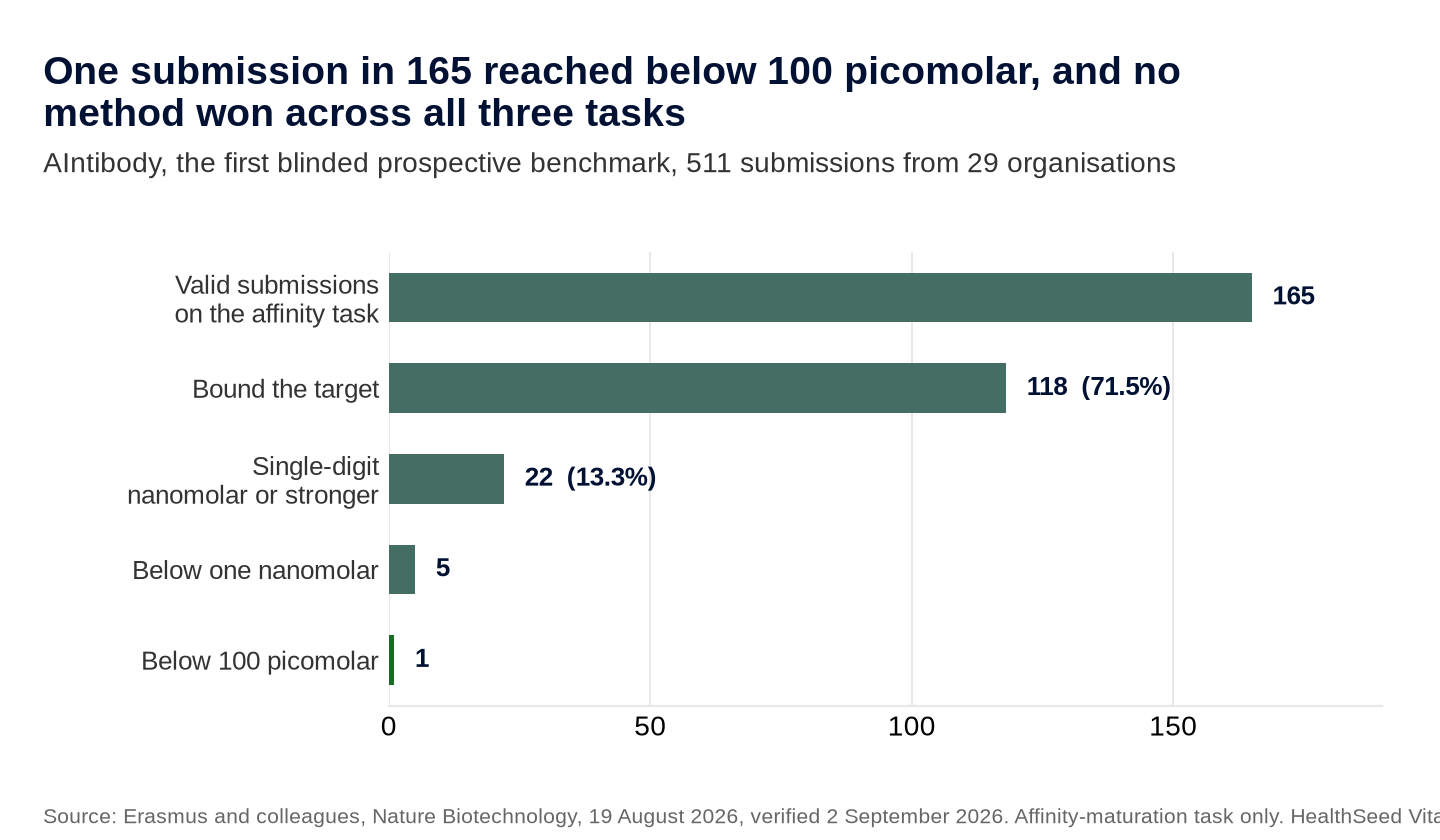
Performance varied widely by group and by task, and no single approach dominated. Two limitations belong with those figures. The first round used a single antigen, and it was organised by the same consortium that reported the results, relying on the organisers' integrity for blinding. Neither dissolves the finding, and both are reasons to treat the second round as the one that settles anything.
Aureka beat three months of phage display in under a week, and only the bench could prove it
Aureka took first, second and fifth place. Its winning design reached 94.7 picomolar against a best experimental control of 113 picomolar, and it also produced six antibodies below ten nanomolar that met the developability bar. The figures are published by Aureka and rest on the paper's own measurements.
The comparison is only worth anything because both were measured the same way, in the same laboratory, against the same target. A third benchmark published on 20 August ran twelve molecular generation methods over 176 protein-ligand systems and found architecture-specific trade-offs with no universally best generator. All three point the same way.
Sources: Erasmus and colleagues, Nature Biotechnology, 19 August 2026. Aureka Biotechnologies, 27 August 2026, figures published by the company. University of Texas Health Science Center at Houston, bioRxiv preprint, 20 August 2026, not peer reviewed.
Applies to you if: you make or evaluate a performance claim for a computational design method.
Money
Adaptyv raised US$40 million to test other people's designs in Lausanne
Adaptyv Bio, the laboratory that built and tested Anthropic's designs, announced a US$40 million Series A on 25 August led by Highland Europe with Ace Ventures, ByFounders and Y Combinator. It reports laboratory throughput up more than fivefold in a year and more than a hundred customers, among them Chai Discovery, Boltz, Roche and Novo Nordisk. It is doubling its team in Lausanne and opening a London laboratory in the fourth quarter.
The company states the thesis in its own words: artificial intelligence can only move as fast as the experiments behind it.
Novo Nordisk buys models from Amazon and bench time from Adaptyv
That is the cleanest evidence in the cycle that the two are separable purchases. On 10 August Novo Nordisk named Amazon Web Services its preferred cloud provider and strategic AI partner, opening a London co-innovation hub built on Amazon Bio Discovery and Amazon Bedrock. It is also on Adaptyv's customer list. The same company is buying design capability from one supplier and the capacity to find out whether the designs work from another.
Aureka closed a US$100 million Series B on 10 August, nine days before it won the benchmark, and directed the money at its closed-loop experimental system alongside larger models. Its own account puts the laboratory inside the platform rather than downstream of it.
Insilico earned US$103.1 million from molecules and US$2.70 million from software
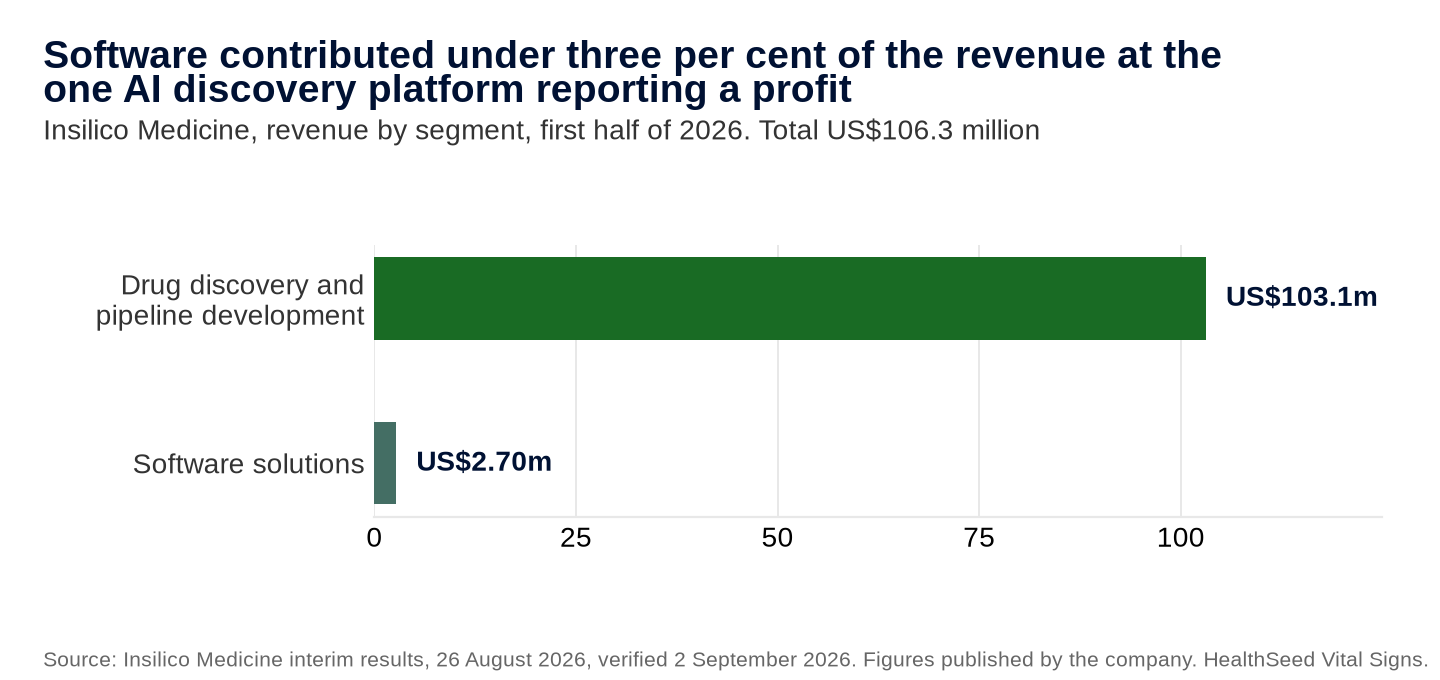
Insilico Medicine reported on 26 August that revenue for the first half of 2026 reached US$106.3 million, up 287.2 per cent year on year at a gross margin of 90.3 per cent, with a net profit of US$35.54 million and cash and investments of US$584.8 million. Drug discovery and pipeline development contributed US$103.1 million of that and software solutions contributed US$2.70 million. Recursion, on 5 August, reported quarterly revenue of US$7.67 million against US$19.22 million a year earlier and cut its 2026 cash operating expense guidance to below US$375 million.
We report the European picture as this cycle found it, which is thin. Adaptyv's round is the only substantial European financing in the category inside the window, and Sightera Biosciences, an Antwerp university spin-off, raised EUR 3 million in July, outside it.
Sources: Adaptyv Bio, 25 August 2026; Novo Nordisk, 10 August 2026; Aureka Biotechnologies, 10 August 2026; Insilico Medicine interim results, 26 August 2026; Recursion Pharmaceuticals, 5 August 2026; QBIC, July 2026. Every revenue, cash and round figure is published by the company it concerns. Insilico's half-year and Recursion's quarter are different periods and are not a comparison. A US$73 million Cradle financing reached this cycle's collection dated 24 August 2026; the round was announced on 26 November 2024 and is not reported here.
Applies to you if: you are raising in European AI drug discovery, or you are deciding what to own and what to rent.
The rules
ICH M15 asks what your model was validated against, and validation happens at the bench
Every movement above ends in the same place, with a regulator reading a dossier and deciding whether the computational work inside it can be relied on. The document governing that reading came into effect on 23 July 2026, twelve days before this cycle opened, and it belongs in this edition because nothing since supersedes it and because almost nobody in the category has read it.
ICH M15, adopted by the regulatory members of the ICH Assembly on 29 January 2026 and implemented in Europe through EMA's Step 5 publication, sets out general principles for model-informed drug development. Its scope names artificial intelligence and machine learning explicitly, alongside population pharmacokinetics, physiologically based pharmacokinetics, exposure-response analysis, model-based meta-analysis, quantitative systems pharmacology, agent-based models, and disease progression models.
It asks six questions of all of them.
| The question | What it wants |
|---|---|
| Question of interest | The specific decision the model is being used to inform, written down before the model is run |
| Context of use | Where the model sits in the submission and what else supports the same conclusion |
| Model influence | How much of the decision rests on the model rather than on experimental data |
| Consequences of a wrong decision | What happens to a patient if the model is wrong in the direction it is most likely to be wrong |
| Model risk | Influence and consequence taken together, which is what sets the evidence burden |
| Model impact | What the model actually changed about the development programme |
The guideline names overfitting as the specific concern for AI and machine learning, and requires assessment of robustness against data, parameters, assumptions and uncertainty. It does not cover the technical detail of how a model is built. Every one of those six answers is written in experimental evidence rather than in model architecture.
Three further pieces landed either side of it. EMA researchers surveyed 273 regulators, industry professionals, patients, academics and healthcare workers in June 2026 and ranked ten regulatory science priorities for AI across the medicine lifecycle; accuracy and reliability of AI tools came first with every respondent group, by a substantial margin. FDA's 2026 CDER guidance agenda, released in February and expressly non-binding, adds planned supplemental guidance on software assurance for AI-based systems in drug manufacturing and clinical investigations. And on 27 August the FDA ran a workshop on model-integrated evidence in generic drug development.
Sources: ICH M15 Step 4 final guideline, 29 January 2026, and EMA Step 5 publication EMA/CHMP/ICH/496426/2024 of 9 February 2026, coming into effect 23 July 2026. The EMA Step 5 PDF did not yield readable text on retrieval, and the detail above is taken from the ICH Step 4 text and from regulatory trade coverage of the adopted guideline, which agree on every date. EMA regulatory science priorities, preprint, June 2026. FDA CDER 2026 guidance agenda, February 2026. FDA model-integrated evidence workshop, 27 August 2026.
Applies to you if: your evidence package contains a computational model that will reach a regulator, directly or through a partner.
Critical deadlines, next nine months
| Date | Market | Event and action required |
|---|---|---|
| 23 July 2026, in force | ICH members | ICH M15 governs documentation of model-derived evidence, AI and machine learning included. **Read it against your own model documentation.** |
| 23 to 27 October 2026 | Europe | ESMO Congress, Madrid, where Insilico's first-in-human data for ISM6331 and Generate Biomedicines' GB-4362 abstract are both accepted. **Diarise both before setting oncology comparables.** |
| First half 2028 | United States | Initial data from Recursion's ZINNIA trial, on the company's own guidance, and the earliest controlled efficacy readout on the record for any candidate here. **Set the date any AI-attrition claim is tested against.** |
The argument
The case against everything above is that one month of capacity financing is not a structural claim. One Series A in Lausanne, one benchmark on one antigen and one half-year result cannot carry a conclusion about where value sits in a field this young, and a reader who has watched three tooling cycles commoditise is right to want more before moving anything.
What survives that is the direction of travel in every piece of evidence the cycle produced. A model with no biology training reached hit rates the specialists publish as their own. Four pharmaceutical companies bought design capability and disclosed nothing, which is what buyers do when a thing is becoming a commodity. The one prospective test of whether any of it works had to be conducted in a laboratory, cost three months of physical work for its comparator alone, and still could not say which method to use next time. And the regulator's own framework asks six questions that are answered with experiments.
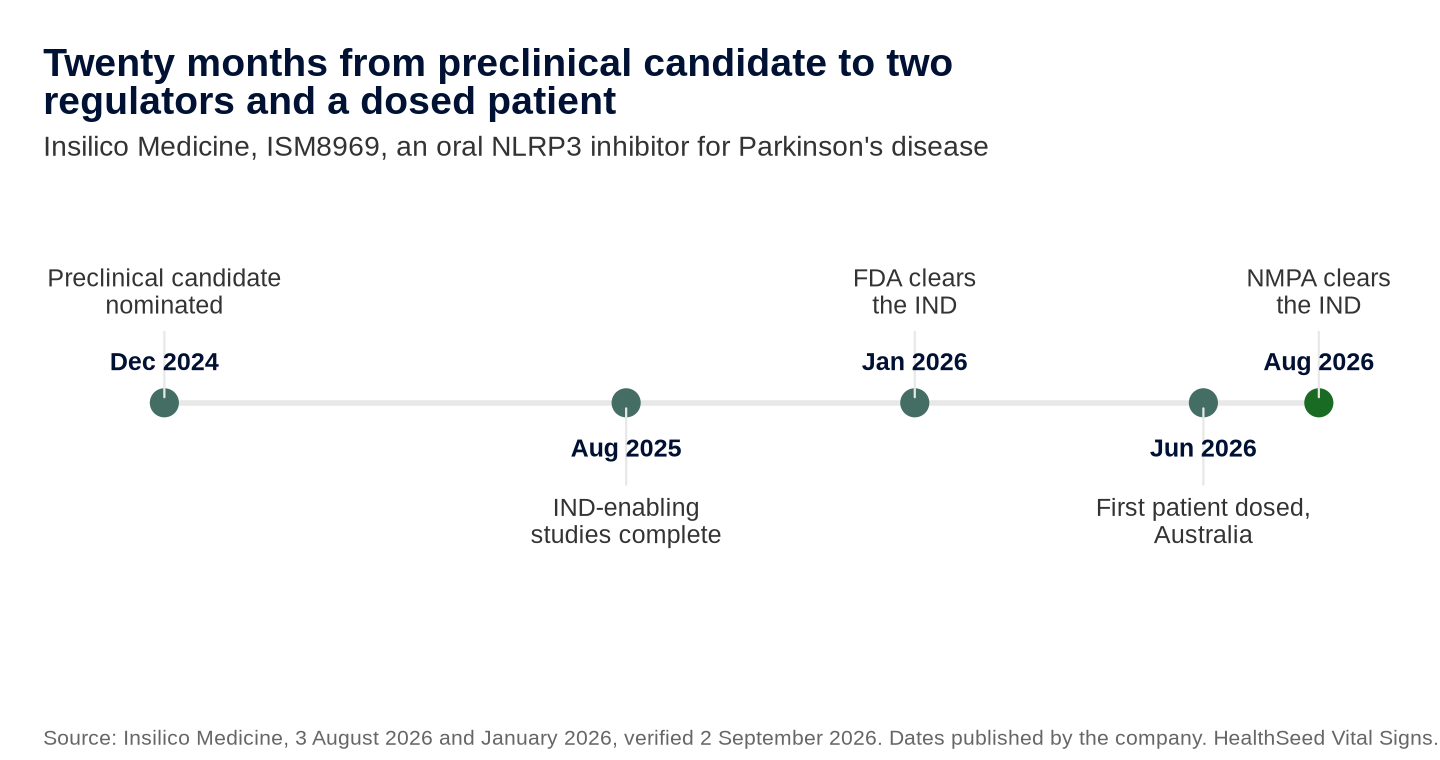
The counter-example is worth holding, because it is the fastest thing in the cycle. Insilico took ISM8969 from preclinical candidate to clearance by two regulators and a dosed patient in twenty months, on a molecule its Chemistry42 engine designed. Even there, the design was the short part. Enabling studies, two regulatory reviews and a first-in-human dose took the other eighteen months, and none of that was accelerated by the model that drew the compound.
For a company building here over the next eighteen months, the practical consequence is that the two halves of the work now carry different prices and different risks. Design capability is a purchase, and it is getting cheaper. The loop that tells you which design was right is an asset, and this month it is what raised money, what a benchmark depended on, and what a regulator will ask you to describe.
What do you own, and what are you renting?
Most companies in this category have not written the answer down, and the two lines have separated far enough this month that the answer is no longer obvious. Establishing it is a few days of work against a documented position, and it can be closed before your next board meeting. We are reachable at contact@healthseed.vc.
About HealthSeed
HealthSeed is a Swiss healthcare venture studio and commercialisation partner. We work alongside biotech, medtech, diagnostics, digital health, and AI companies as they enter and scale across Europe, the United States, and the Middle East and North Africa, backed by an Expert Community of more than 35 specialists and a network of partners who have run the functions they advise on. We also build ventures and AI products of our own, so we read this market as participants. Vital Signs is where we publish what we are reading and what we think it means, with a primary source behind every claim.
HealthSeed AG, Weidmannstrasse 5, 8046 Zürich, Switzerland. CH-020.3.056.106-6.
Sources
- 1Anthropic, autonomous de novo protein design with independent testing by Adaptyv Bio and Twist Bioscience, 18 August 2026, not peer reviewed. https://www.anthropic.com/research/Claude-accelerates-protein-design
- 2Schrödinger, strategic collaboration and software agreement with Bristol Myers Squibb, 5 August 2026. https://ir.schrodinger.com/press-releases/news-details/2026/Schrdinger-Announces-Strategic-Collaboration-and-Software-Agreement-with-Bristol-Myers-Squibb-to-Deploy-AI-Co-Scientist-Bunsen-for-Agentic-Drug-Discovery/default.aspx
- 3Chai Discovery, collaboration with Bristol Myers Squibb, 19 August dateline, reported 20 August 2026. https://www.businesswire.com/news/home/20260819146905/en/Chai-Discovery-Announces-Collaboration-with-Bristol-Myers-Squibb-to-Advance-AI-Driven-Antibody-Discovery
- 4Phylo and Chugai Pharmaceutical, Biomni Lab deployment, 4 August 2026. https://phylo.bio/blog/chugai-partnership
- 5Phylo and Ono Pharmaceutical, 28 July 2026. https://www.prnewswire.com/news-releases/ono-pharmaceutical-partners-with-phylo-to-embed-agentic-ai-with-every-discovery-scientist-302835864.html
- 6Novo Nordisk and Amazon Web Services, strategic partnership, 10 August 2026. https://www.novonordisk.com/news-and-media/news-and-ir-materials/news-details.html?id=916594
- 7Evotec and Odyssey Therapeutics, AI-enabled R&D collaboration, 6 August 2026. https://www.evotec.com/news/evotec-and-odyssey-therapeutics-enter-ai-enabled-r-d-collaboration-in-autoimmune-and-inflammatory-diseases
- 8Relation Therapeutics and GSK, expanded collaboration, 30 July 2026, outside the cycle window. https://www.relationrx.com/news/relation-announces-expanded-collaboration-with-gsk
- 9Aqemia and Sanofi, target nomination and milestone, 22 July 2026, outside the cycle window. https://aqemia.com/news
- 10Erasmus and colleagues, a blinded, prospective benchmark of in silico antibody discovery anchored to experimental affinity and developability, Nature Biotechnology, 19 August 2026. https://www.nature.com/articles/s41587-026-03238-6
- 11Aureka Biotechnologies, AIntibody benchmark result, 27 August 2026, figures published by the company. https://www.manilatimes.net/2026/08/27/tmt-newswire/pr-newswire/nature-biotechnology-aureka-wins-the-global-blinded-ai-antibody-benchmark-ai-design-surpasses-the-best-experimental-result/2412994
- 12Aureka Biotechnologies, US$100 million Series B, 10 August 2026. https://www.aurekabio.com/news/61
- 13University of Texas Health Science Center at Houston, benchmark of twelve molecular generation methods, bioRxiv preprint, 20 August 2026, not peer reviewed. https://www.biorxiv.org/content/10.64898/2026.08.14.744939v1
- 14Adaptyv Bio, US$40 million Series A, 25 August 2026. https://www.adaptyvbio.com/blog/series-a
- 15Insilico Medicine, interim results for the first half of 2026, 26 August 2026. https://www.prnewswire.com/news-releases/commercialization-roadmap-validated-with-three-digit-million-dollar-revenue-insilico-medicine-announces-interim-results-for-the-first-half-of-2026-302860466.html
- 16Insilico Medicine, NMPA IND approval for ISM8969 in Parkinson's disease, 3 August 2026. https://www.eurekalert.org/news-releases/1138579
- 17Insilico Medicine, FDA Fast Track designation for ISM6331, 29 July 2026, outside the cycle window. https://insilico.com/news/034jeh2rl1-insilico-medicine-receives-fda-fast-trac
- 18Recursion Pharmaceuticals, second quarter 2026 results, REC-7735 IND clearance and the Genentech target option, 5 August 2026. https://ir.recursion.com/news-releases/news-release-details/recursion-reports-second-quarter-financial-results-genentech
- 19Generate Biomedicines, second quarter 2026 results and GB-4362 Phase 1 status, 5 August 2026. https://generatebiomedicines.com/news-releases/generate-biomedicines-inc-reports-second-quarter-2026-financial-results-and-provides-business-update/
- 20QBIC, pre-seed financing for Sightera Biosciences, July 2026, outside the cycle window. https://www.qbic.be/nieuws/qbic-iii-provides-pre-seed-funding-to-sightera-biosciences
- 21ICH M15, general principles for model-informed drug development, Step 4 final guideline 29 January 2026, in effect 23 July 2026. https://database.ich.org/sites/default/files/ICH_M15_Step4_Final_Guideline_2026_0129.pdf
- 22EMA Step 5 publication of ICH M15, EMA/CHMP/ICH/496426/2024, 9 February 2026. https://www.ema.europa.eu/en/documents/scientific-guideline/ich-m15-guideline-general-principles-model-informed-drug-development-step-5_en.pdf
- 23EMA researchers, regulatory research priorities for AI use in the medicine lifecycle, preprint, June 2026, outside the cycle window. https://zenodo.org/records/20554817
- 24FDA, 2026 CDER guidance agenda, February 2026, expressly non-binding. https://www.fda.gov/media/185228/download
- 25FDA, workshop on model-integrated evidence in generic drug development, 27 August 2026. https://sbiaevents.com/web20260827/