
Why European Health Companies Stall Before They Scale
European venture funds have returned 8.6 per cent a year against 14.6 per cent in the United States. That caution reads as a failure of ambition until you look at the 532-day median wait between European approval and European reimbursement.

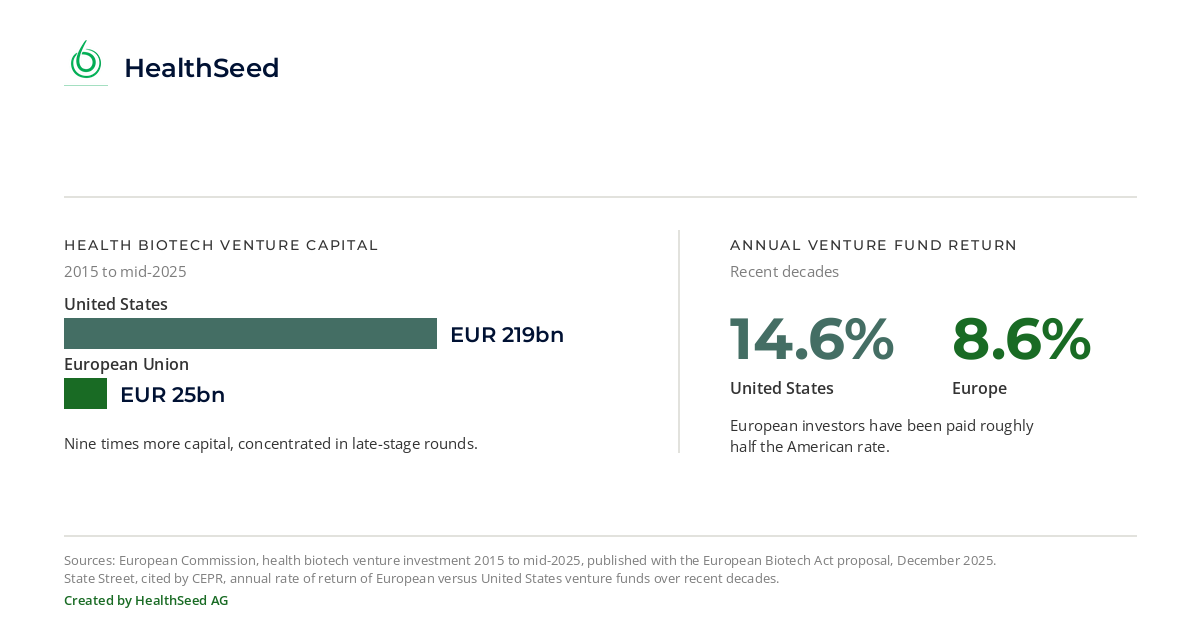
European health companies rarely stall for lack of capital. They stall at the point where capital becomes expensive. Between 2015 and mid-2025, health biotech companies in the United States raised roughly EUR 219 billion in venture funding, against EUR 25 billion for companies in the European Union, a difference of about nine times, and the shortfall concentrates in late-stage rounds rather than early ones. The science either side of that gap is comparable. What Europe does not reliably supply is the growth capital a company needs at the moment it has to cross twenty-seven separate reimbursement systems, and the reason sits on both sides of the transaction.
The gap is a late-stage gap
The European Commission's own figures, published alongside the European Biotech Act proposal in December 2025, put health biotech venture investment in the United States at around EUR 219 billion between 2015 and mid-2025, and at EUR 25 billion in the EU over the same period. The EU accounts for roughly 7 per cent of global venture capital investment in health biotech.
Aggregate wealth is not the binding constraint. Across all sectors, European venture funding reached EUR 66.2 billion in 2025, about 22 per cent of the amount deployed in the United States, between two economies of broadly similar size. The money exists in Europe. The channels that would carry it into a Series B or a Series C in a health company are the part that is missing. The Commission's response runs through a Health Biotech Investment Pilot with the European Investment Bank Group, targeting around EUR 40 billion a year for a decade, alongside a EUR 10 billion allocation to startups.
Public capital attempting to correct a private-market failure of that size tells you the failure has been diagnosed. It does not tell you the diagnosis is complete.
The caution has a return series behind it
European investors are routinely described as too conservative. The description skips the arithmetic they are working from.
State Street data cited by CEPR puts the annual rate of return of European venture funds in recent decades at 8.6 per cent, against 14.6 per cent for United States funds. An institution allocating to European venture has been rewarded at roughly half the American rate over a long horizon. A pension fund that hesitates in front of that series is not displaying a failure of ambition. It is reading its own history correctly.
The question worth asking is what depresses the series, and for health companies specifically the answer is legible in the access data.
What fragmentation costs after approval
Marketing authorisation in Europe is a European event. Reimbursement is twenty-seven national ones.
The EFPIA Patients W.A.I.T. Indicator 2025 Survey, published in May 2026 with data correct to January 2026, measures the interval between marketing authorisation and the point at which a medicine reaches patients. The median across European countries is 532 days. Germany reaches patients in 56 days and Romania in 1,201, an access disparity of 88 per cent between the highest and lowest performing European country.
The availability picture has moved in the wrong direction. In 2025, 49 per cent of the centrally approved innovative medicines in the cohort were unavailable to patients somewhere in Europe, against 46 per cent in 2019. Full availability on public reimbursement lists fell from 42 per cent in 2019 to 28 per cent in 2025, while availability under restricted conditions rose from 6 per cent to 17 per cent.
For anyone building a company rather than reading a policy paper, a product approved centrally is a product with a median year and a half of commercial silence ahead of it in the average market, and considerably longer in several. That silence sits directly on top of the period when the company most needs revenue to raise its next round.
And the sequence does not compound in the founder's favour. A German reimbursement decision is evidence for a French submission rather than a substitute for it. Success in one market shortens the next negotiation without removing it.
Regulation (EU) 2021/2282 addresses part of this. The Joint Clinical Assessment has applied to oncology medicines and advanced therapy medicinal products since January 2025, extends to orphan medicinal products in 2028, and covers all new medicinal products from 2030. It harmonises the clinical assessment. Pricing and reimbursement decisions remain a national competence, so the dossier converges while the decision that matters commercially stays where it was.
One further gap deserves naming, because the W.A.I.T. Indicator measures medicines only. For medical devices, diagnostics, and digital health there is no equivalent published series tracking the interval between CE mark and reimbursement across European markets. Founders in those categories face the same fragmentation without the benefit of a number they can put in front of an investor. A delay nobody measures is a delay nobody is under pressure to fix.
The discount, and who collects it
Put the two datasets next to each other and the mechanism resolves.
A European health company spends the years after approval assembling market-by-market access. Throughout those years it is worth less than it will eventually be worth. That discount is not a verdict on the science. It is the price of a market structure that makes the science slow to convert into revenue.
An American investor or acquirer looking at the same company is not underwriting the national dossier. It is underwriting the platform, with a home market that reimburses on a different logic and a balance sheet capable of carrying a European access build afterwards. The discount European fragmentation creates is therefore available to be collected, and it is frequently collected from outside Europe.
Argenx is the case most often cited by European operators. The company listed on Euronext Brussels and then pursued a dual listing on NASDAQ, where its chairman has publicly described raising more than 4 billion dollars. The science was European. A substantial share of the value creation that followed was not.
A founder who takes American growth capital is behaving as rationally as the European investor who declined to provide it. Both are responding to the same structure from opposite ends.
What would change the arithmetic
Four changes would move the numbers, and none of them is a matter of investor sentiment.
Capital has to be able to follow a company across a border at the scale a Series B requires. The Health Biotech Investment Pilot is a serious attempt at this, and its test is whether it crowds private capital in rather than substituting for it.
The Joint Clinical Assessment has to shorten national timelines in practice. That outcome depends on member states adapting local methods to incorporate the JCA report rather than running it in parallel with what they already required.
Access delay in devices, diagnostics, and digital health needs to be measured on the W.A.I.T. model. The medicines figure exists because an industry association chose to publish it for six years running, and it now anchors every serious conversation about European access.
European strategics could underwrite earlier. An acquirer that waits for completed reimbursement in two or three markets is outsourcing that risk to a buyer who will not wait, and then buying the same technology back later at a price that includes the waiting.
For a company inside the constraint today, the practical move is sequencing rather than advocacy. Choose the first two markets on the basis of what the evidence package you already hold can actually clear, build the second submission from the first rather than starting it fresh, and put the access timeline in front of investors as a schedule rather than leaving it as an unpriced risk they will discount for you. Europe's fragmentation is a fixed cost for the next several years. It can be planned against.
Europe's funding gap is usually quoted as EUR 25 billion against EUR 219 billion. The more useful figure is 532 days, because the wait is what makes the gap rational.