
Vital Signs
Twelve CE marks and a September registration cliff
Three things came off European markets in this cycle. A handheld device used to check that a feeding tube has reached the stomach was ordered destroyed across the NHS because the company that made it had stopped trading. An implant business seventeen years old was wound down because its board could not justify funding the next validation package. A catheter was withdrawn in six countries in five days over a manufacturing specification. Against that, ten companies announced twelve European certificates in ten days, and two registration deadlines and one notified body milestone now fall inside the next sixteen weeks.

European medical device market access in 2026 is gated by registration and post-market obligations as much as by certification. Three deadlines bind manufacturers before the end of the year: a signed written agreement with a notified body by 26 September 2026 for Class C in-vitro diagnostics self-declared under the old directive, EUDAMED registration by 28 November 2026 for devices placed on the market before 28 May 2026 and still being sold, and the swissdamed transition closing on 31 December 2026. EUDAMED and swissdamed share no data, so a device sold in both markets is registered twice, and both registers withdraw the transition from any device under a serious incident report, a field safety corrective action, or a trend report.
01 Certification
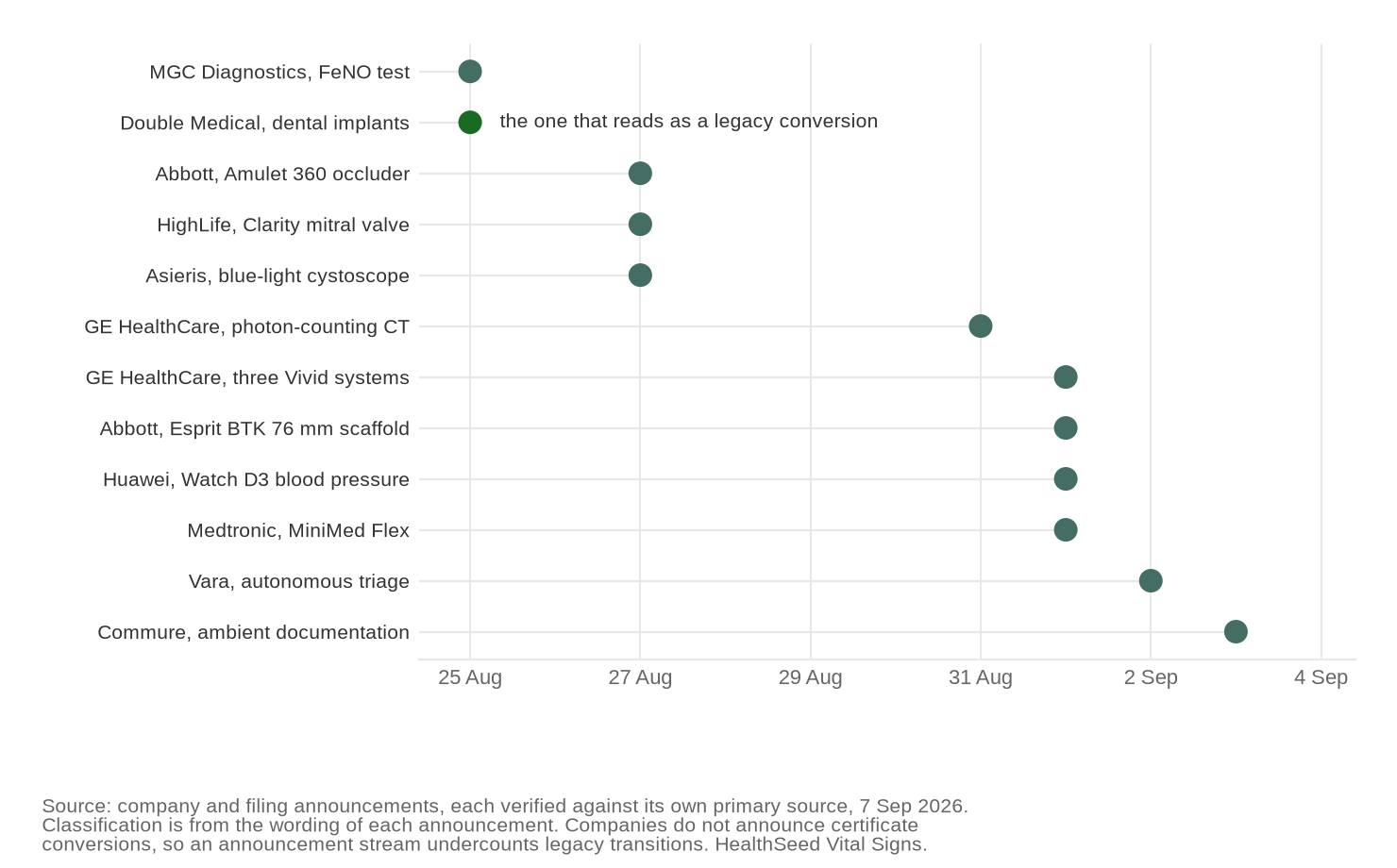
Ten companies announced twelve CE marks or EU Medical Device Regulation certificates between 25 August and 3 September, Abbott and GE HealthCare taking two each. The CE mark is the manufacturer's declaration, checked for most devices by an independent organisation called a notified body, that a product meets EU law and may be sold across the bloc. No public regulator approves a device in Europe the way the Food and Drug Administration does in the United States. A private body designated by a member state does the checking and issues the certificate.
Abbott, GE HealthCare and Medtronic all took European certificates inside ten days
Figure 1 lists the twelve. Abbott took a CE mark for an implant that seals the pouch in the heart where clots form in atrial fibrillation, on a 400-patient study in which implantation succeeded in 99.8% of cases. GE HealthCare took two, covering a photon-counting CT scanner already selling in the United States and Japan and three cardiovascular ultrasound systems. Medtronic reported one for an insulin delivery system, with a European launch from November.
The MDR transition queue is the obvious explanation, and it fits one of the twelve
A reader who follows European device regulation reaches for the same explanation, and it is a good one. Under Regulation (EU) 2023/607, devices certified under the old directives may stay on the market until 31 December 2027 if they are Class III or implantable Class IIb, and until 31 December 2028 below that. Those extensions were conditional on milestones that have all passed: a compliant quality system and an application to a notified body by 26 May 2024, and a signed agreement with that body by 26 September 2024. Every legacy device still lawfully on sale therefore sits in a queue that has to discharge before those dates, and notified body capacity governs the rate. A run of MDR certificates in late 2026 is what that queue discharging looks like.
It does not account for this set. Eleven of the twelve announcements describe a new device, a new indication, a new size, or a first entry into the EU. Asieris states that its cystoscope is the company's first EU product registration. GE's scanner was already selling elsewhere. Vara's certificate covers a mode of operation that did not previously exist. Only Double Medical's dental implant certificate reads like the conversion of an existing one, and dental screws and plates are among the categories the 2027 date expressly excepts.
The limit on that finding matters more than the finding. Companies announce new products and announce nothing when an existing certificate is converted, so an announcement stream undercounts legacy transitions by design. What this cycle shows is that the transition does not explain this cluster of announcements, which is a narrower claim than saying it is not driving certificate volume.
A notified body certified Vara to report a normal mammogram without a radiologist
The most consequential of the twelve went to a Berlin company on 2 September. Vara holds an EU MDR Class IIb certificate for autonomous triage in organised breast screening, which permits examinations the software classifies as clearly normal to be reported without a radiologist reading them. Every other examination still goes to at least one radiologist. Around 97% of screening images turn out normal, and more than half of Germany's organised programme already runs on Vara's software at over 250,000 screenings a month.
The evidence is unusual for the category. The certificate rests on PRAIM, published in Nature Medicine in 2025, a prospective study across 461,818 women at twelve German sites, in which the tool's cancer detection rate was reported as non-inferior and statistically superior to the control. Vara also built a supervisory layer, ATMON, which sets each site's operating point and reverts that site to full radiologist reading when performance signals move outside defined limits.
Fimea told device makers the AI Act's disclosure duty applies now and the high-risk rules apply in 2028
Finland's medicines agency published guidance on 25 August. The AI Act's Article 50, which requires telling people they are dealing with an AI system and labelling AI-generated content, took effect on 2 August 2026 whatever risk class a system falls into. The high-risk obligations for AI built into a regulated product, which is where an AI-enabled device sits, moved to 2 August 2028 under Regulation (EU) 2026/1744.
Vara built ATMON to supply the continuous human oversight the AI Act will demand of high-risk systems, and that demand is now two years away. The certificate the company actually holds came from the Medical Device Regulation, which never moved.
Applies to you if: you are taking a device or diagnostic into a European market in the next eighteen months, or you hold a company whose plan assumes the certification route has become faster.
02 Registration
A device can hold a valid certificate, be in production, and be selling, and still come off the market because a database entry is missing. Europe and Switzerland each run a register in which every device, manufacturer and importer has to be listed for the product to stay on sale lawfully. Both are closing their transition arrangements inside the next four months, and neither knows what is in the other.
Switzerland and the EU set device-database deadlines six weeks apart, in systems that do not exchange data
EUDAMED, the European register, became mandatory on 28 May 2026, and any device placed on the market before that date whose units are still being sold has to be registered by 28 November 2026. Swissmedic made registration in swissdamed mandatory from 1 July 2026, with a transition to 31 December 2026. The two systems have no interface, so a registration in one does nothing for the other and every device sold in both markets is entered twice.
Switzerland charges for registration and the EU does not
Both registers withdraw the transition from any device under a vigilance action. A device subject to a serious incident report, a field safety corrective action, or a trend report registers immediately in swissdamed from 1 July, and the same carve-out applies in EUDAMED, where a legacy device under a vigilance action has to be registered at once so that the report can be filed. The companies with the least administrative capacity to spare, because they are running a corrective action, are the ones neither register gives time to.
What is Swiss is the bill and the date. Fees run at 200 francs for the first device identifier and 20 francs for each additional one, capped at 10,000 francs a year, with the first invoices going out from January 2027 and covering registrations already made. The transition closes on 31 December 2026, six weeks after the European one, and clearing EUDAMED does nothing for swissdamed.
A Class C diagnostic that missed 26 May needs a signed agreement by 26 September to keep the market until 31 December 2028
In-vitro diagnostics, meaning tests run on samples taken from the body, run on their own timetable under Regulation (EU) 2024/1860. For a Class C test, which is one whose wrong result carries serious consequences for the individual patient, the application to a notified body was due on 26 May 2026, the signed written agreement with that body is due on 26 September 2026, and a device clearing both may stay on the market until 31 December 2028. Class D, the highest risk band, ran a year earlier at every point and ends on 31 December 2027. Class B and Class A sterile run a year later and end on 31 December 2029.
Lodging the application preserves nothing on its own. A Class C test without a signed agreement on 26 September loses its transitional status and cannot lawfully be placed on the EU market, eighteen days after this edition publishes.
Regulation (EU) 2024/1860, as set out in the European Commission's Q&A on the extension of the IVDR transitional periods. Verified 7 September 2026.
Applies to you if: you place any device on the Swiss market, hold any legacy in-vitro diagnostic in the EU, or have a Class C test that was self-declared under the old directive.
03 Withdrawal
Six field actions ran through European and US registers in this cycle, and the number of regulators each one reached bore no relation to the harm its manufacturer had reported.
The MHRA ordered every NGPod device destroyed because the manufacturer had stopped trading
NGPod Global made a handheld device that tests pH to help confirm a feeding tube has reached the stomach rather than the lung. On 24 August the MHRA required every NHS organisation to identify, quarantine and dispose of all NGPod devices and sensors. The company ceased trading on 20 July, could no longer support the product, and could not accept returns, so the devices could not be sent back and had to be destroyed in place.
The device has a safety history and it belongs here. In January 2026 the MHRA received two UK adverse incident reports, one with a fatal outcome, in which the device returned a green result indicating correct placement while the tube was in the lung. The agency said multiple factors likely contributed to the death and that a contributing role of the NGPod result could not be ruled out. A corrective action followed, and the manufacturer added contraindications and clarified that the system alone does not confirm where a tube has gone.
That history produced a corrective action and a revised label. What removed the product seven months later was the company ceasing to exist, and the MHRA's own notice says the trading cessation is not directly related to a current safety concern.
Boston Scientific's catheter defect reached six national registers in five days on two reported injuries
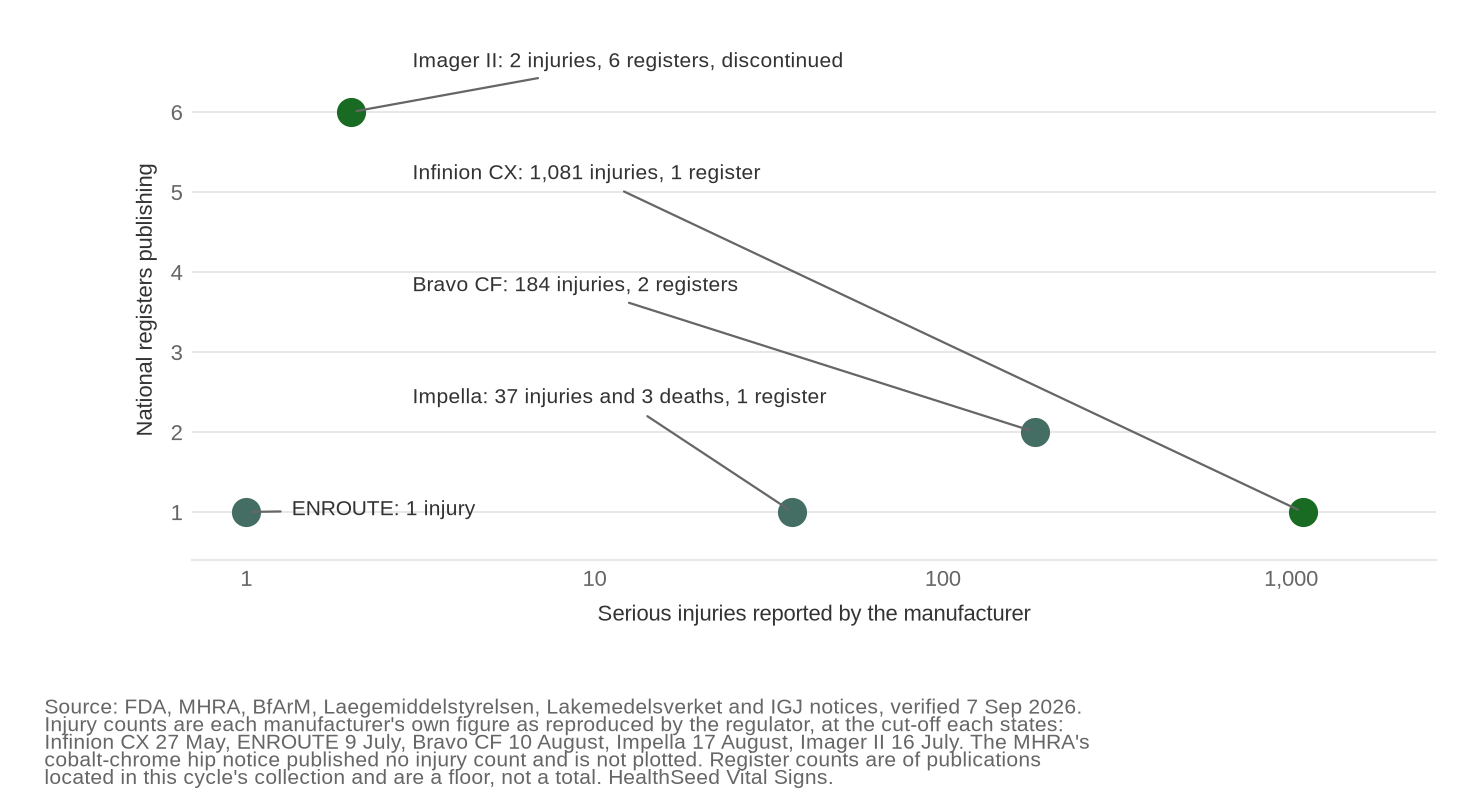
Between 24 and 28 August, the Danish, German, Swedish, Dutch and British authorities and the FDA each published on the Imager II angiographic catheter. Boston Scientific had made the catheters with reduced levels of stabilising agents in the tips, which could cause a tip to degrade and detach. The company reported two serious injuries and no deaths as of 16 July. The usual consequence of a detachment is a delay while the device is exchanged, and the most serious, described as remote, is a fragment obstructing blood flow. Boston Scientific removed the product and then discontinued it.
Four Class I recalls in nine days, and the Impella action is the fourth on that family in a year
Class I is the FDA's most serious recall category, used where a defect could reasonably cause serious injury or death, and it has nothing to do with the European device risk classes. Four landed inside the window. Boston Scientific's ENROUTE carotid protection catheters were classified Class I after reports of sheath tip separation, on one reported serious injury as of 9 July. Its Infinion CX spinal cord stimulator leads followed on 3 September over fracture at the anchor point, on 1,081 reported serious injuries as of 27 May, which is the largest count in the cycle by a factor of six. Medtronic and Given Imaging removed the Bravo CF pH capsule delivery device on 184 reported serious injuries. Abiomed recommended removal of all Automated Impella Controllers after failures in the component that tells the controller a purge cassette is seated, on 37 serious injuries and three deaths reported as of 17 August. Every one of those harm counts is the manufacturer's own figure as reproduced by the regulator.
The Abiomed action is the fourth on that product family since September 2025, after a purge retainer recall, a cassette removal and a sensor correction. A single Class I alert reads as an engineering defect. Four in twelve months reads as a component problem a company is working through in public.
Set the two ends of that range against each other. Boston Scientific's catheter reached six national registers on two reported serious injuries, while the same company's stimulator lead sits at 1,081 and appears in one. How far a defect travels through the regulatory system is governed by how many markets the product is sold in and how many authorities publish. It does not track the harm the manufacturer has reported.
Applies to you if: you sell a device in more than two European countries, or your diligence on a device company stops at the certificate and does not reach the vigilance file.
European startups
The European Investment Bank lent Tensive half of what one CE mark and one launch will cost
Tensive, in Milan, makes a sponge-like resorbable scaffold placed in the cavity left after a breast tumour is removed, so the patient's own tissue regrows into it. On 3 September the European Investment Bank signed a convertible loan of up to €20 million, drawable in tranches of €8 million and €12 million at twenty-year maturity and backed by InvestEU. A convertible loan is debt the lender can turn into equity later, which lets a company take money without setting a valuation.
The figure that matters is what the €20 million is half of. The bank's own announcement states that it covers half of a €40 million financing plan to take the product through CE marking, manufacturing scale-up and EU launch, with approval anticipated as early as 2027. That is a lender's published number for one implantable device, reached after reading the clinical and regulatory file in detail.
iPremom raised €15 million to take a blood test for pre-eclampsia through EU and US approval
Pre-eclampsia affects between five and eight per cent of pregnancies, and there is no preventive treatment beyond aspirin, which works best when started early. Identifying who is at risk in the first trimester is therefore the whole game, and it has not been possible from a blood sample.
iPremom, founded in Valencia in 2019 by Carlos Simón and Tamara Garrido, announced €15 million in seed funding on 2 September, led by Amadeus Capital Partners through its APEX Technology Fund and co-led by Asabys Partners. Its test, MaiRa, reads cell-free RNA from a single maternal blood sample and models risk across several pregnancy complications from as early as nine to fourteen weeks. The platform was built on the PREMOM study, more than 26,000 samples linked to 10,000 pregnancies across fourteen Spanish hospitals.
The test is already available in Spain through the company's own laboratory. The money is for commercial launch, completing validation studies, and regulatory approval in the EU and the United States.
Selection is editorial and unpaid. Companies under an active HealthSeed engagement are excluded.
Critical deadlines
Every date below was verified against this cycle's sources and none is carried forward from a previous edition.
| Date | Instrument | What happens |
|---|---|---|
| 26 September 2026 | Regulation (EU) 2024/1860 | Signed written agreement with a notified body due for Class C diagnostics self-declared under the IVDD |
| 16 October 2026 | Docket FDA-2025-N-6224 | Comments close on the FDA's proposed Class I accessory list |
| 28 November 2026 | EUDAMED, Regulation (EU) 2024/1860 | Devices placed on the market before 28 May 2026 and still being sold must be registered |
| 2 December 2026 | Regulation (EU) 2026/1744, Article 50(2) | Content-marking duties reach systems already on the market at 2 August 2026 |
| 31 December 2026 | Swissmedic, swissdamed | Swiss transition closes for devices on the market before 1 July 2026 |
| January 2027 | Swissmedic | First swissdamed invoices issue, covering registrations already made |
| 25 February 2027 | Implementing Regulation (EU) 2026/977 | Binding notified body timelines and quotation rules apply |
| 31 December 2027 | Regulation (EU) 2023/607 | Legacy Class III and implantable Class IIb devices leave the market |
| 2 August 2028 | Regulation (EU) 2026/1744, Annex I | High-risk obligations reach AI embedded in medical devices |
| 31 December 2028 | Regulation (EU) 2023/607 | Legacy Class IIa, Is, Im and remaining Class IIb devices leave the market |
The argument
The case against reading this cycle as anything other than an ordinary vigilance month is strong and should be put properly. Four Class I recalls landed in nine days. A purge flag failed, a sheath tip separated, a stimulator lead fractured at its anchor, and a capsule failed to release. Those are engineering failures in the plainest sense, they produced 1,303 reported serious injuries and three deaths between them, and any account treating them as administrative is describing something other than what happened.
The distinction that survives it is what those actions did. Each removed lots or units, and in every case the product family continues. Nothing in this cycle removed a product from a European market because a notified body or a regulator found that it failed its performance claims.
What removed products was of a different kind. NGPod's devices were destroyed across the NHS because the company that supported them stopped trading, and the MHRA said so in terms. Episurf's implant business was wound down because a board compared a validation package against a property portfolio. Boston Scientific discontinued a catheter over a stabilising agent. Two registration deadlines and one notified body milestone will take further devices off two markets over the next sixteen weeks without any authority examining a single one of them.
For a company selling a device in Europe over the next two years, the failure modes worth insuring against have moved. Certification has a process, a fee and a queue you can see. Solvency, registration and the capacity to answer six authorities in a working week have no process attached, and this is the cycle in which each of them removed a product.
About HealthSeed
HealthSeed is a Swiss healthcare venture studio and commercialisation partner. We work alongside biotech, medtech, diagnostics, digital health, and AI companies as they enter and scale across Europe, the United States, and the Middle East and North Africa, backed by an Expert Community of more than 35 specialists and a network of partners who have run the functions they advise on. We also build ventures and AI products of our own, so we read this market as participants. Vital Signs is where we publish what we are reading and what we think it means, with a primary source behind every claim.
HealthSeed AG, Weidmannstrasse 5, 8046 Zürich, Switzerland. CH-020.3.056.106-6.
Sources
Every entry below was opened and checked on 7 September 2026. Where a figure comes from a manufacturer's own reporting rather than an independent finding, the line in the body says so.