
Vital Signs
HealthTech, September 2026: Sweden's €630m record-system write-off
The system ran for three days before it was pulled as unsafe for patients. What did work this cycle was a nurse with a task list, a search of a patient registry and a letter in the post, and one of those cut deaths by 22 per cent.


Two Swedish health regions abandoned the same hospital record system in 2026, four months apart, after spending about 630 million euros between them and never running it in routine care. In the same period, three randomised trials found that the measurable gains in care delivery came from nurse follow-up, a patient-registry search and a posted letter, one of which reduced deaths by 22 per cent. Health systems are finding that the binding constraint is follow-through rather than technology.
What to do about it
Three findings this cycle each change what a company has to do next. Everything else, including the cycle's financings, is summarised in the tables below.
| Priority | What happened | What it means you should do |
|---|---|---|
| ACT NOW | Two Swedish regions abandoned the same hospital record system. About 630 million euros written off, and no Swedish site left running it. | Re-check any Nordic plan built around that platform. The systems worth integrating with are the old ones, extended to 2036, and both regions now buy component by component. |
| ACT NOW | Three randomised trials found the gains in nurse follow-up, a database query and a posted letter. One of them cut deaths by 22 per cent. | Rewrite your comparator slide. Say what your product adds over a nurse working from a list, and what it costs a health system to run that same workflow with people. |
| MONITOR | Medicare republished the table that decides what it can pay for. Digital therapy delivered as software has no category. The same therapy inside a headset is billable equipment. | Establish which side of that line you are on before your next US revenue plan. The decision is commercial, and engineering usually takes it years earlier. |
The record system
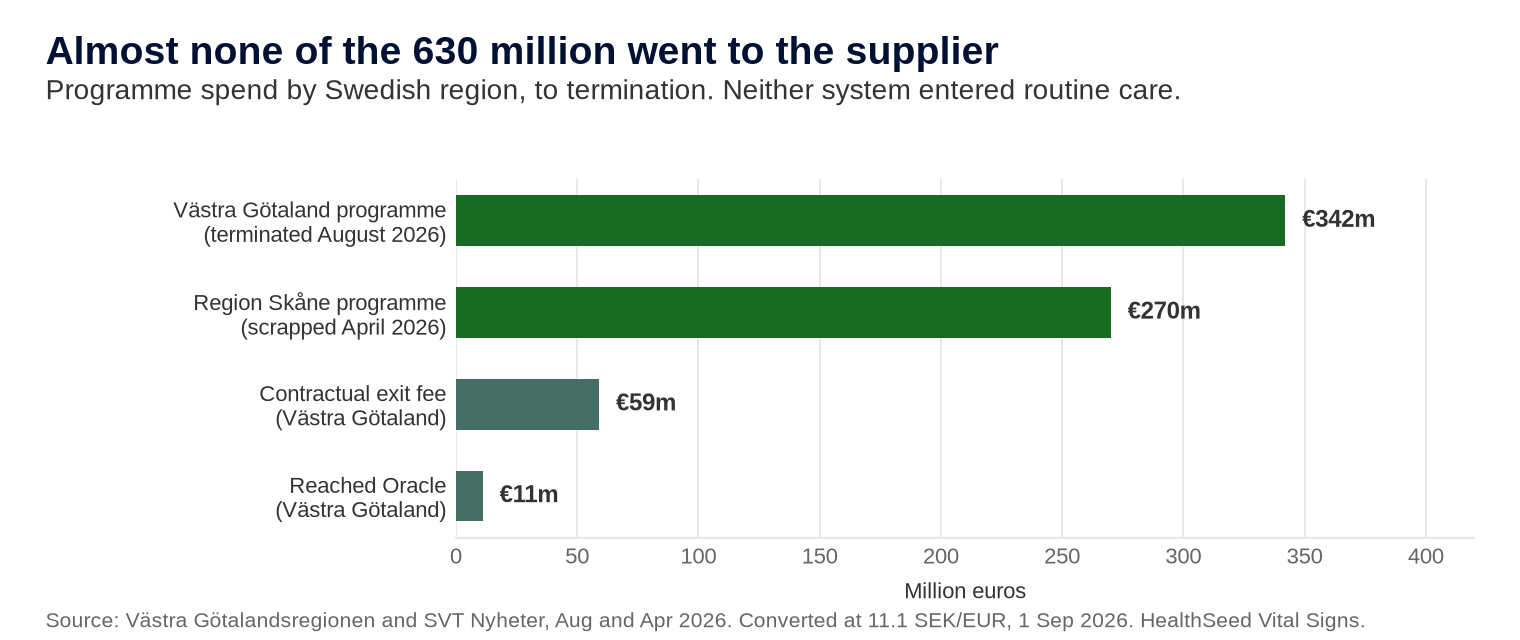
Two Swedish regions wrote off 630 million euros on the same record system. A hospital record system is the software every clinician touches on every shift, and replacing one is the largest technology decision a health region ever makes. Two Swedish regions have just abandoned the same replacement, four months apart, having spent about 630 million euros between them. Neither system ever ran in routine care.
The system is Millennium, the record platform Oracle acquired when it bought Cerner in 2022, and Sweden was its most visible European reference site. It now has no Swedish customer.
Västra Götaland, Sweden's second largest health region, signed in 2018. It switched Millennium on in part of the region in autumn 2024 and switched it off three days later, having judged it was not safe for patients. The programme never restarted. On 27 August its board voted unanimously to terminate, and the agreement was signed the next day for 59 million euros, a figure fixed in kronor at 657 million. That sum is an exit fee written into the 2018 contract, not damages and not a settlement of any dispute.
The full programme cost about 340 million euros. Only 11 million of that ever reached Oracle. The rest went on the region's own staff, its consultants, and eight years of work.
Region Skåne, building the same platform under the name SDV, got there first and quietly. It postponed its rollout indefinitely in January, concluded in March that this generation of the software would never be usable for its clinicians, and stopped the programme in April after about 270 million euros.
Three things this changes for anyone selling into Northern Europe. First, what to integrate with. Västra Götaland has extended the systems it was replacing: Melior, its medical records system, and Obstetrix, its maternity system, by eight years; SAMSA, which coordinates care between the region and its municipalities, by four with an option on four more; and three further systems to 2036. A product built to connect to Millennium has nobody in Sweden to sell to.
Second, who the buyer is. Both regions have committed to buying component by component instead of one platform. That replaces a single decade-long contract with a run of smaller ones, each awarded on whether that component works. More openings, shorter contracts, and an advantage to a supplier who can prove one thing over one who promises everything.
Third, what suppliers get asked. A procurement officer who has watched two neighbouring regions write off 630 million euros will want evidence that a product has run in live clinical use, and will ask what happens if it has to be switched off mid-shift. Most early-stage companies answer the first question badly and have never been asked the second at all.
Edition 001 reported that the record vendors had absorbed ambient documentation into the systems they already sell, and that the window for independent vendors in that layer was closing. That holds on the product side and needs a second clause. A platform can only absorb a capability in the hospitals where it is actually running, and in Sweden it is now running in none.
Applies to you if: your product connects to a regional or national record system in Europe, or your pipeline assumes a single-platform buyer on the other side of the table.
Outcomes
Three trials found the same bottleneck, and none of them fixed it with software. Cardiology's largest annual meeting produced three randomised trials in two days, and together they say something sharper than any of them says alone. In each case the treatment already existed and the evidence for it was settled. What was failing was follow-through: finding the right patient, starting them on it, and noticing between appointments when that stopped.
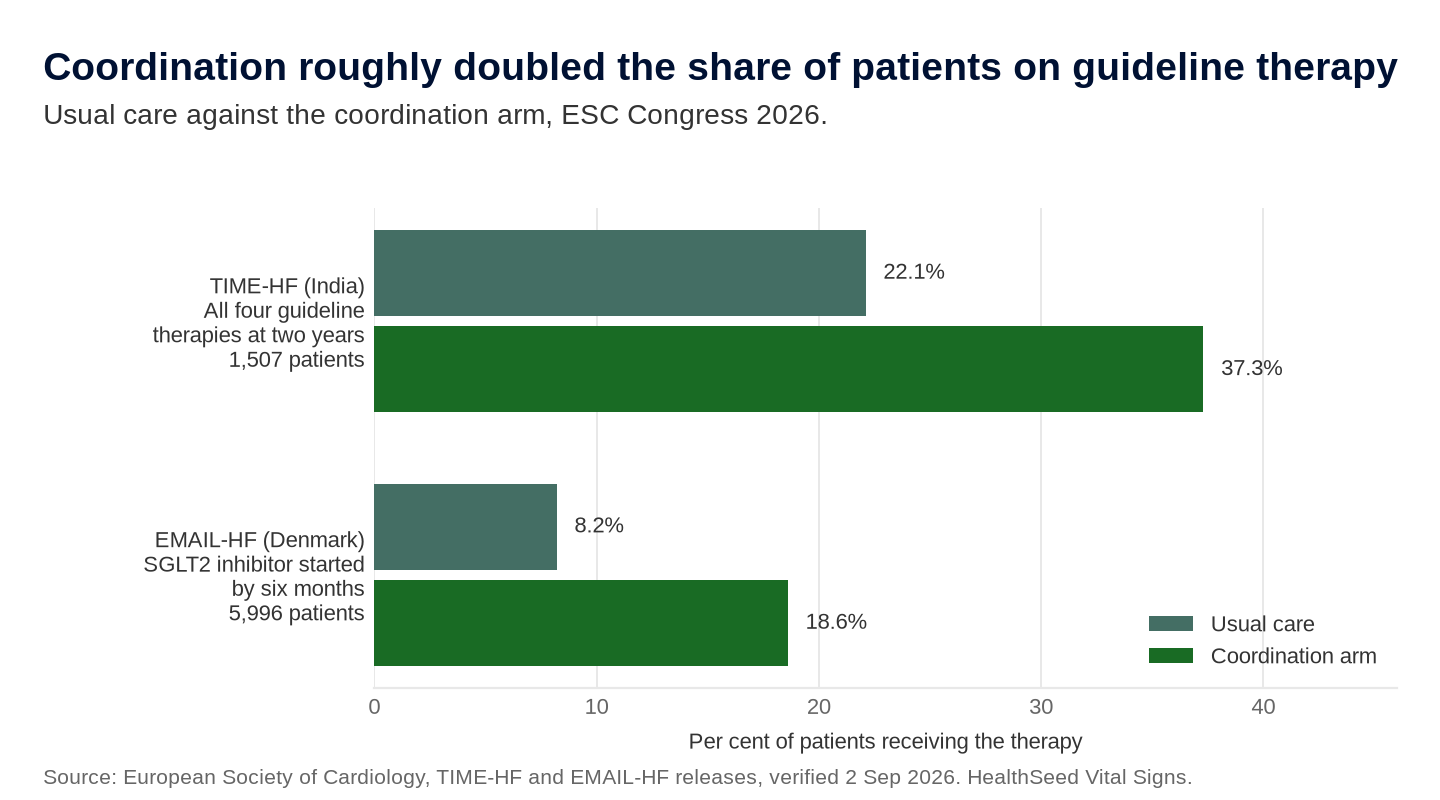
TIME-HF is the largest and the only one that moved mortality. Heart failure has four drug classes proven to extend life, and the problem everywhere is that most eligible patients are on some but not all of them. Across 1,507 patients in 22 Indian centres, trained nurses working alongside physicians through a phone app raised the share on all four from 22 to 37 per cent over two years. Deaths fell by 22 per cent. Nothing in that trial was a new drug, a new device, or an algorithm.
EMAIL-HF tested the cheapest version of the same idea. Danish investigators searched a national patient registry for heart-failure patients missing one proven drug class, wrote to them through the government's digital post service, and offered a phone call with a specialist who had read their record first. Prescribing more than doubled, from 8 to 19 per cent within six months, and the gap was still open two years later. The instrument was a database query and a letter.
VIRTUES took the principle to monitoring. Among 1,115 Canadian patients with pacemakers and implanted defibrillators, reviewing the device data remotely was as safe as bringing them into clinic, judged on death, stroke and hospitalisation at 18 months, and just as quick to a clinical decision. It cost 77 Canadian dollars less per patient, which the investigators scale to roughly ten million a year across Canada.
The comparator is now a nurse with a task list. Health systems have spent two years being asked to buy clinical intelligence. The three results published in Munich were produced by a nurse working from a list, a search of a patient registry, and a letter in the post, at a cost a finance director can approve without a business case. Anything sold against the same outcomes is measured against that from now on.
So the buyer's question changes. It stops being whether the software works and becomes what it adds over the cheap thing that already has a randomised trial behind it. That is harder, and it is answerable. None of these three interventions scales without somebody maintaining the list, and all of them fail at the point where a human has to notice that the follow-up never happened.
Which is where the product is. The companies best placed after this week are the ones supplying that administrative layer rather than competing with it: the systems that find the untreated patient, route them to the right clinician, and record whether anything actually followed. It is unglamorous work, it is what all three trials were really testing, and it is the part no health system can staff indefinitely.
Applies to you if: you sell a care-delivery or clinical-decision product into a health system, or you are raising on a thesis that assumes the coordination layer is unsolved.
Coverage
Medicare pays for the headset and not for the software inside it. The third finding is about which of these things actually gets paid for, and the answer does not track whether they work. Before Medicare can cover something it needs a benefit category, a classification saying what kind of product it is. No category means no route to payment, whatever the evidence. On 28 August the agency republished the table that assigns them.
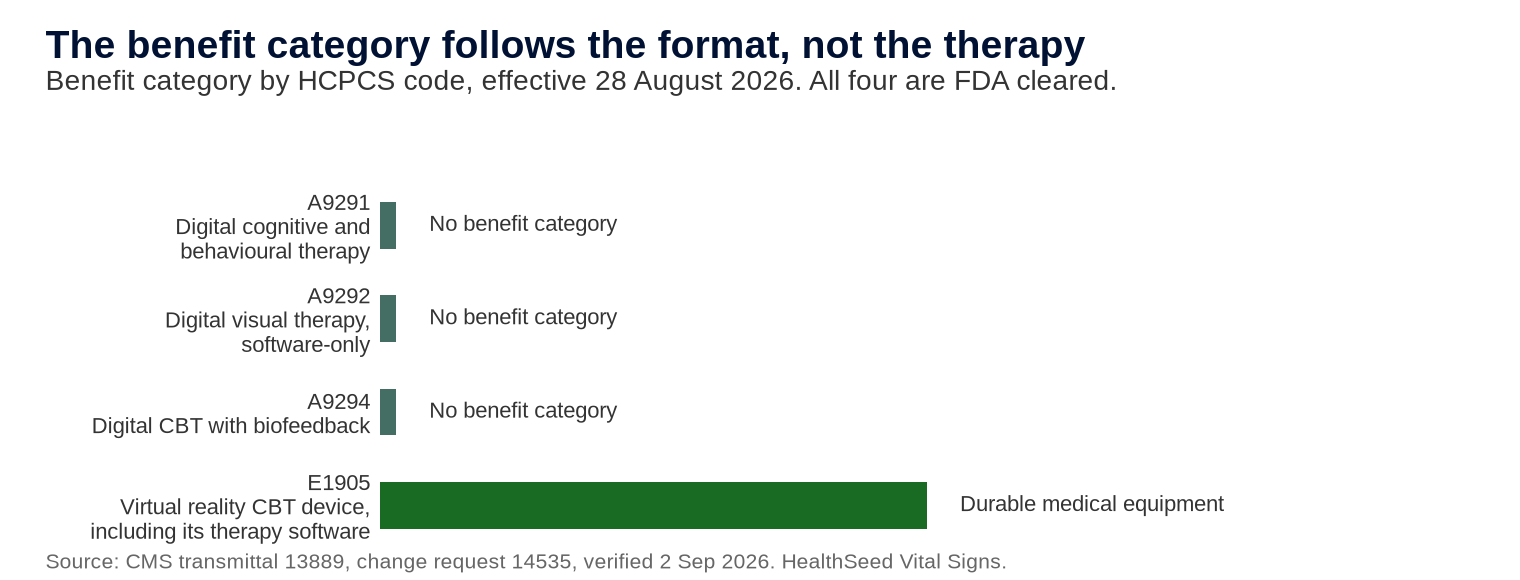
Four billing codes in that table describe prescription digital therapy, one of them labelled software-only in the code text itself. Every one carries the same entry: no category. Code E1905, a virtual reality device for cognitive behavioural therapy including the therapy software loaded on it, is classified as durable medical equipment and is therefore billable. The therapy is the same. What differs is that one arrives in a box.
Payers tightened elsewhere the same week. UnitedHealthcare moves its rules on where scans may be performed, and its cardiac genetic testing policy, from 1 September. In Germany, the Federal Joint Committee, which decides what statutory insurance covers, opened assessment procedures on 27 August for a transplant-rejection test and for cardiac imaging, both procedural steps rather than payment decisions.
Applies to you if: you sell prescription digital therapy in the United States, or your roadmap still has an open question about whether the product ships as software or as hardware.
Capital and deals
| Company | Base | What it does | Round |
|---|---|---|---|
| Scan.com | US | Imaging network and its booking layer | $220m: $90m equity, $130m debt |
| N-Power Medicine | US | Community oncology research network | $32m Series B |
| Metriport | US | Aggregates scattered patient records | $26m Series A |
| Onos Health | US | Behavioural health, sold to health plans | $17m Series A |
| Lupin Dental | France | Dental robotics | €15m Series A |
| Holifya | Italy | Digital obesity clinic. Trade coverage only | €2m, €1.6m of it equity |
| Trellus Health | UK | Digital chronic care, listed in London | Administrators appointed 24 August |
Dates that bind
| Date | What applies |
|---|---|
| 28 August 2026In effect | The republished Medicare table applies. Digital therapy delivered as software has no payment category. |
| 1 September 2026In effect | UnitedHealthcare's rules on where scans may be performed, and its cardiac genetic testing policy, apply to commercial plans. |
| End 2026 | Region Skåne reports on what replaces its record programme, setting the integration surface for southern Sweden. |
| 2036 | Västra Götaland's extended contracts for three retained systems run to this date. |
The argument
Capital spent the same week going the other way. The two largest rounds above fund the layer that moves patients, records and results between institutions that already exist. The largest European round was 2 million euros.
The reasonable reading of that is the opposite of this edition's. Three trials in India, Denmark and Canada describe public systems with national registries and salaried nurses, none of which a founder can assume. Two failed procurements in one country are two procurements. Capital is paid to be right about where value accrues, and it has just put a quarter of a billion dollars into that routing layer.
Grant all of it, and one thing survives. Everything that produced a measured, published, randomised result this cycle was organisational and cheap. Everything expensive was cancelled, unpayable, or still asking to be evaluated. That is a claim about what can currently be proved, and the gap widened this cycle rather than closing.
For a company the consequence is specific. The buyer has watched a neighbouring region write off 630 million euros and will want evidence of live clinical use. The comparator is a nurse with a list, and it now carries a mortality figure. Whether a product is paid for at all may turn on whether it ships as software or as hardware. Those three questions sit with different people inside a company, and this is the cycle in which all three moved at once.
About HealthSeed
HealthSeed is a Swiss healthcare venture studio and commercialisation partner. We work alongside biotech, medtech, diagnostics, digital health, and AI companies as they enter and scale across Europe, the United States, and the Middle East and North Africa, backed by an Expert Community of more than 35 specialists and a network of partners who have run the functions they advise on. We also build ventures and AI products of our own, so we read this market as participants. Vital Signs is where we publish what we are reading and what we think it means, with a primary source behind every claim.
HealthSeed AG, Weidmannstrasse 5, 8046 Zürich, Switzerland. CH-020.3.056.106-6. contact@healthseed.vc