
HealthTech, August 2026: every AI scribe Ontario tested made an error
Athenahealth, Oracle and Microsoft folded the AI scribe into the record system in eleven days. Ontario tested twenty approved scribes and every one produced an inaccuracy. Spain and the EHDS wired more of the data layer that will decide who can sell into Europe. Abu Dhabi started requiring approval for digital health products. Aisel Health’s EUR 1.7 million pre-seed was the cycle’s only clean European round.

The capability an independent vendor sold last year now ships inside the record system, and the only multi-vendor evaluation any public body has published found inaccuracies in all twenty systems it tested.
About this publication
This is the premiere issue of Vital Signs: HealthTech. Every two weeks it covers what is moving in care delivery and health infrastructure: the technology reaching health systems, market entry, investment and funding, regulation, and the practices that work. Europe and Switzerland lead, with the United States and MENA carried where they matter to a European builder.
If you are building in health tech, investing in the category, or advising the companies that do, this is the brief to read for what changed and what it means for the decision in front of you. Every claim names an actor, carries a date, and links to a primary source. Where a figure is published by a company about itself, we say so in the line where it appears.
This edition covers 11 to 26 August 2026 in five movements, deployment, evidence, the data layer, governance, and money, followed by the dates that bind and the argument. Health systems are buying enterprise clinical AI faster than anyone is evaluating it, while the infrastructure that will decide who can sell into Europe is being specified now, on a clock that runs to 2029. The finding that will travel furthest was published in May by an auditor in Ontario, and it reached almost none of the health systems that spent this cycle buying at scale.
Deployment
Athenahealth, Oracle and Microsoft shipped native ambient documentation inside the record system. An ambient scribe listens to a consultation and drafts the clinical note from it, which removes the largest single piece of administrative work most clinicians carry. Until this month it was a capability a health system bought from a company that was not its record vendor, and Abridge and Ambience built the category on precisely that gap. In eleven days in August, the record vendors closed it.
Athenahealth put a native ambient scribe in front of 170,000 clinicians. Oracle Health released clinician-facing coding and chart-review agents into general availability. Microsoft made its Dragon Copilot apps and agents generally available and opened its own ambient audio and clinical note context to outside developers. Epic released diagnostic image exchange between Epic systems, removing one further reason to buy a standalone product.
No single one of those is a large announcement, and together they move ambient documentation from something a health system buys into something it already owns.
The scale involved is already substantial. Cleveland Clinic onboarded more than 4,000 ambulatory clinicians onto one ambient platform in four months and published the account. Abridge says its tooling now reaches over 300 enterprise health systems covering 250 million patients, a figure the company publishes about itself.
Cedars-Sinai, Mount Sinai and ten more now buy diagnostic AI as one bloc. The more consequential movement in this cycle happened on the buying side and went almost unremarked. Twelve American health systems, among them Cedars-Sinai, Houston Methodist, Mount Sinai, Northwell and Sutter Health, formed a diagnostic AI consortium with Aidoc on 11 August. Together they serve close to 20 million patients a year on the participants’ own figure. A group of that size evaluates once and commits on behalf of all twelve.
A vendor therefore faces a market where the capability is being absorbed into the software the customer already runs, and where the customers who remain are buying in groups large enough to set terms. That is pressure from both sides at once, and the independent vendor sits between them. A health system that has put 4,000 clinicians onto one platform in a quarter has settled its documentation layer for years, and the workflow a founder is selling into now has an incumbent supplier and a renewal date.
Evidence
Cleveland Clinic’s AI scribe study was co-written by the vendor that sold it. The most detailed public description of an enterprise ambient deployment yet published is a joint document, and its author list is the part to read first. The paper appeared in npj Health Systems in August and carries twelve authors, six of them at Cleveland Clinic and six at Ambience Healthcare, the vendor the hospital selected. The competing-interests statement records that the Ambience authors hold equity in the company. A control condition is the comparison group that shows what would have happened without the intervention, and the study reports none, alongside no independent verification.
Its central operational finding is that tying vendor payment milestones to clinician onboarding volumes accelerated the rollout, which is a procurement insight and the most transferable thing in the paper. Reported alongside it, and repeated widely in trade coverage, is that 60 per cent of clinicians using the scribe agreed it increased their likelihood of remaining in practice.
That last figure records how clinicians felt about a tool their employer had just given them, captured inside a deployment both parties had an interest in describing as successful. It may well prove directionally right, and it is a different kind of finding from the one the coverage described.
Ontario tested twenty approved AI scribes and every one made errors. Ontario’s Auditor General published a special report on 12 May 2026 covering artificial intelligence across the provincial public service, including the vendor-of-record process for AI scribes used by physicians. The date places it outside this cycle, and it belongs in this edition for a reason the end of this item gives.
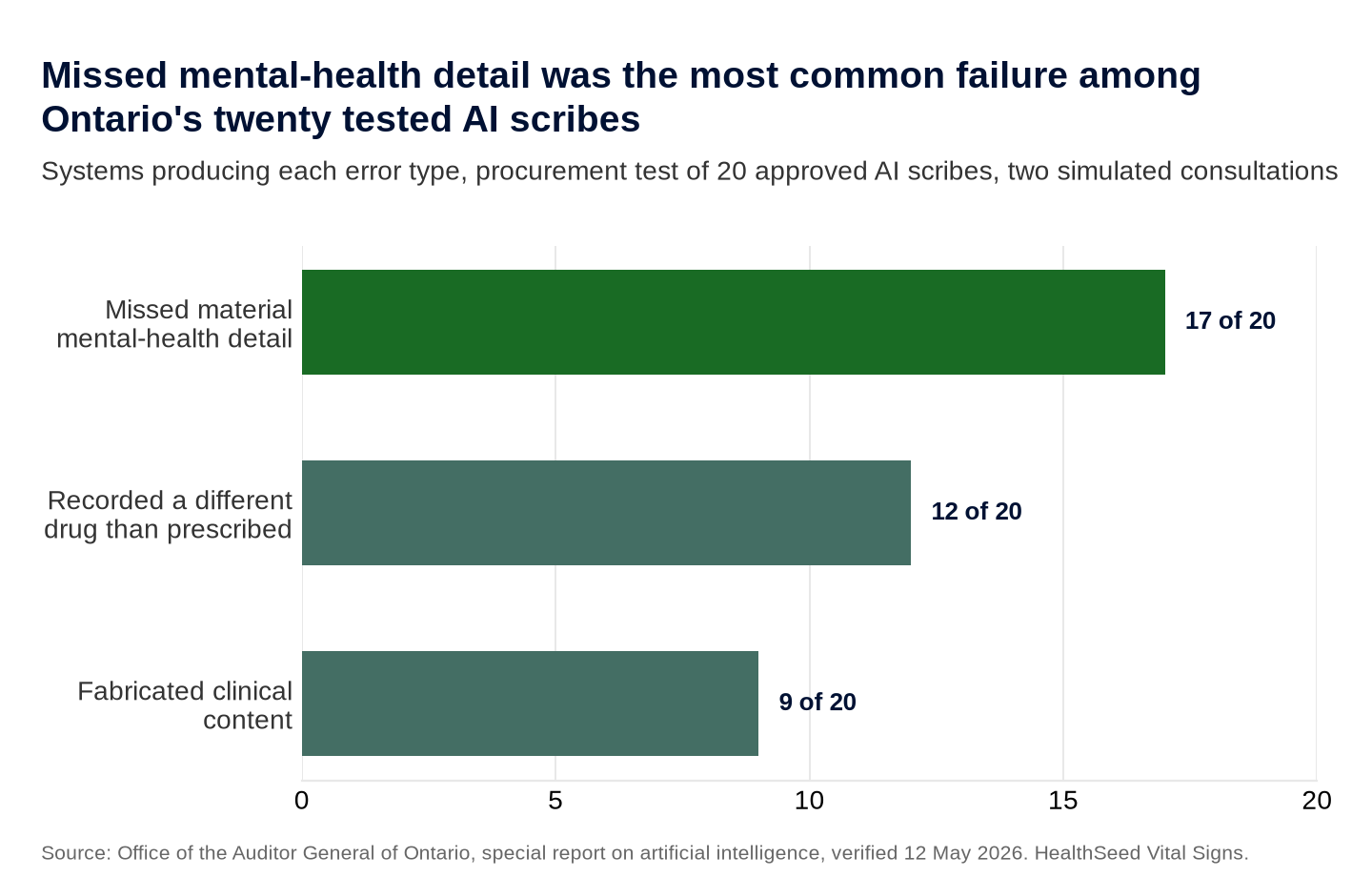
Twenty approved systems were tested against two simulated doctor-patient conversations. Every one produced at least one inaccuracy. Nine fabricated clinical content, including referrals and blood tests that had not been discussed. Twelve recorded a different drug from the one the doctor prescribed. Seventeen missed material mental-health detail in at least one test.
Two caveats belong with those numbers and neither of them dissolves the finding. Ontario’s responsible minister noted that the errors were found during procurement testing, before any clinical use. A Canadian consultant who writes on healthcare AI observed that the testing examined 2024-era systems, that the industry has known about fabrication for years, and that every serious deployment assumes clinician review.
It matters anyway, because it remains the only systematic multi-vendor evaluation any public body has published, and because the deployments described in movement one are running at a scale that will make the next such evaluation consequential for everyone selling into the category.
The data layer
Spain is wiring its regions into one national health data system. Spain is assembling a national health data system one regional agreement at a time, and it is publishing each agreement in the state gazette months or years before any supplier is invited to tender against it. Two more were published this cycle.
The first, on 12 August, covers the Community of Madrid, the Madrid Health Service, and Red.es. It provides for a national health data catalogue and repository, for interoperable medical imaging infrastructure, and for artificial intelligence use cases drawing on the National Health Data Space. The second, on 13 August, extends comparable arrangements to Ceuta and Melilla through INGESA, with rare disease diagnosis and monitoring named among the intended use cases.
Why should a founder in Zurich or Berlin care what Spain publishes in its gazette? Because of what these documents are, and when they appear. Neither is a procurement notice and neither names a supplier. Both sit earlier in the sequence than a tender does, and that is where their value lies. An agreement establishing a national data catalogue determines what a supplier will later be required to interoperate with.
Twenty-nine countries closed the consultation that writes Europe’s health data rules. The European Health Data Space Regulation took effect on 26 March 2025. Its secondary-use provisions, which govern the use of health records for research, regulation, and product development as distinct from the care of the patient who generated them, do not apply until March 2029. The practical guidance is being written now.
TEHDAS2 is the joint action writing it, coordinated by the Finnish Innovation Fund Sitra across 29 European countries and funded through EU4Health. It published in this cycle the outcome of its third and final consultation round. That round ran from May to June 2026 and drew more than 500 responses on seven draft guidelines covering international data access, data linkage, and the duty to tell a citizen when their records have been reused. The joint action runs to 31 December 2026, and its outputs then inform Commission implementing acts.
A founder reading that sequence should take one thing from it. The rules governing secondary use of European health data are being drafted in public by a process that has now closed its consultation, and the companies that will find compliance cheap in 2029 are the ones reading those guidelines in 2026.
Governance
Abu Dhabi began requiring approval for digital health products on 18 August. The Department of Health in Abu Dhabi brought its Digital Products Governance Standard into effect on 18 August. The standard covers healthcare-sector digital products including software, telemedicine services, wearables, and artificial intelligence technologies, and requires them to pass governance, risk, and licensing processes covering privacy and security, with departmental approval where applicable.
On the same day the department updated its Health Information Exchange standards. Providers must now use the 2026 data standards and minimum data sets for anything transmitted from electronic medical records and reference laboratory systems to Malaffi, the emirate’s health information exchange.
Abu Dhabi signed Microsoft, Capgemini and MBZUAI into its health AI build. Five days before the standard took effect, the department named the partners it intends to build with. On 13 August it contracted with Capgemini on artificial intelligence for operational and regulatory use cases, with Statista on unified hospital quality metrics, and with Mohamed bin Zayed University of Artificial Intelligence on frontier technology integration. A separate agreement with Microsoft covers a population health intelligence framework drawing on clinical and environmental data alongside behavioural indicators, and a Global AI Healthcare Academy was announced with MBZUAI and Core42 to build workforce capability.
Together those announcements describe an authority setting the terms of entry before the market matures. For a European or Swiss founder the practical reading is straightforward. Abu Dhabi has published its requirements, named the exchange a product must integrate with, and said what it wants partners for, and that is a different proposition from a market that is merely growing.
Money
Aisel Health’s EUR 1.7 million pre-seed was the cycle’s only clean European round. We report this as the cycle found it. Across the two weeks, the visible financing activity in European care delivery and health infrastructure amounted to very little, and saying so is more useful than assembling a movement out of American rounds and calling it a market read.
Aisel Health, a Danish company building a psychiatry-specific operating system covering intake, clinical documentation, billing codes, and record synchronisation, raised EUR 1.7 million in pre-seed funding led by Caesar Ventures and announced it on 19 August. One pre-seed round proves very little on its own. We name it because the shape of the company is the shape the earlier movements imply will survive, which is a narrow clinical specialty with workflow deep enough that a platform vendor has no reason to build it.
Dates that bind
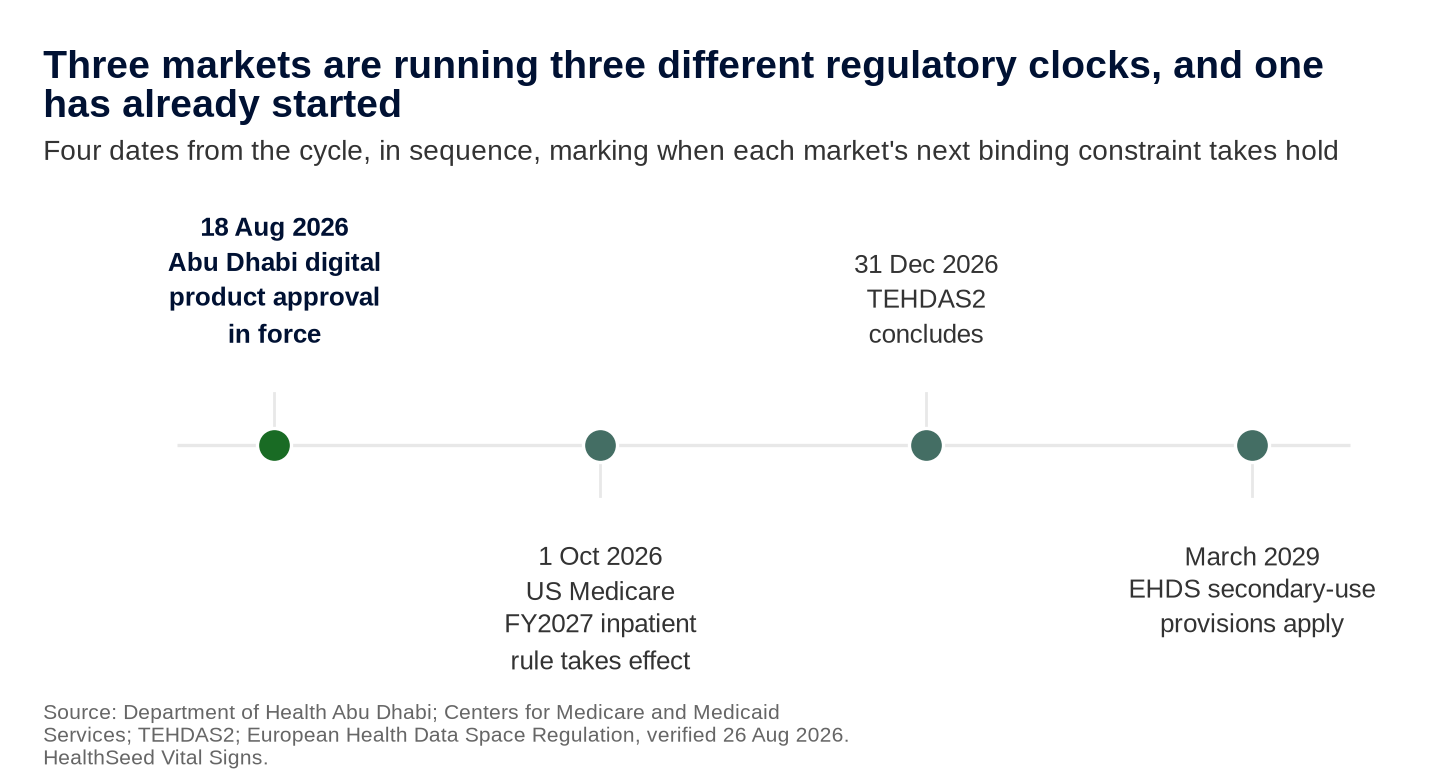
Four dates from this cycle that belong in a planning document.
| Date | What binds | Who it reaches |
|---|---|---|
| 18 August 2026, in effect now | Abu Dhabi's Digital Products Governance Standard applies to healthcare digital products, and the emirate's 2026 Health Information Exchange data standards apply to transmissions to Malaffi. | Digital health products and providers in Abu Dhabi |
| 1 October 2026 | The United States Medicare inpatient payment rule for fiscal 2027 takes effect, raising rates by 2.3 per cent and adding approximately $779 million for cases involving new medical technologies. | Companies billing US Medicare inpatient care |
| 31 December 2026 | TEHDAS2 concludes, and its guidelines pass to the European Commission to inform implementing acts. | Anyone building on European health data |
| March 2029 | The secondary-use provisions of the European Health Data Space Regulation apply. | Companies planning European expansion on this horizon |
The argument
Three markets are running three clocks, and a founder has to choose which one to build against. The United States is buying at enterprise scale on evidence nobody independent has produced, which makes it the fastest route to revenue and the most exposed when a payer or a regulator eventually asks for a control arm. Europe is building infrastructure first and buying later, on a statutory horizon that reaches 2029, which makes it slow and legible, and unusually forgiving to a company willing to read the specifications while they are still drafts. The Gulf is writing its rules ahead of the market, which makes entry conditional and the conditions knowable.
None of those is the correct answer for every company. What is common to all three is that the decisive documents are public. The npj paper, the Ontario audit, the Spanish gazette agreements, the TEHDAS2 consultation outcome and the Abu Dhabi standards were all published in the open inside a single two-week cycle. Each one tells a builder something about what their buyer will ask for next.
The companies that reach health systems are usually the ones who read them first.
About HealthSeed
HealthSeed AG is a Swiss healthcare venture studio and commercialisation partner. We work across biotech, MedTech, diagnostics, HealthTech, and AI in healthcare, on three fronts: international healthcare commercialisation, joint ventures and AI products, and an expert ecosystem that supplies talent, deal flow, and market access. Market entry runs in both directions, United States into Europe and Europe into the United States, with MENA alongside.
Behind the firm sit more than 35 specialists in our Expert Community and around ten Network Partners, drawn from regulatory affairs, market access, clinical development, and commercial leadership across European healthcare.
Vital Signs is how we publish what we are reading. Six tracks, primary sources, and a stated position where the evidence supports one. If something in this edition bears on a decision you are taking, we are reachable at contact@healthseed.vc.
Vital Signs: HealthTech is produced by HealthSeed AG, Weidmannstrasse 5, 8046 Zürich, Switzerland. CH-020.3.056.106-6.