
AI Healthcare, September 2026: Medicare paid $1,000 for one AI scan
Approval used to close an evidence programme, and this cycle two regulators built approvals that do not finish, while Medicare showed that a clearance settles nothing about who pays. The FDA authorised two AI devices their makers may keep changing, a commission reporting through the MHRA asked for approval in stages, and of four large imaging studies only one followed what happened to the patient.


The FDA and the MHRA's commission pushed the demand for evidence past the day a product launches, and Medicare refused to pay for a cleared device.
Two regulators spent this cycle building approvals that do not finish. A company holding a twelve-year-old FDA clearance asked Medicare for a billing code, put its objection in writing when the answer came back no, and was refused again, while a different class of software now collects a four-figure national rate. Four large studies showed that medical software reads images accurately, and one of them followed what then happened to the patient.
Underneath those events is a change in who defines sufficient evidence, and when. Approval used to close an evidence programme. It is becoming a state that keeps asking, because an authorisation can stay open and go on requiring data from the field, and a billing code has to be argued for before anyone pays.
Payment follows the same logic more exactly than most plans assume. Where a specialty organised itself and carried a billing code through, the money arrived. Where a device fell outside the category Medicare may pay for at all, no coding effort would have reached it.
The approval terms
On 3 September the FDA approved a piece of heart software and agreed in advance that the company could keep changing it. A week later a commission reporting through the MHRA asked for approval to be handed out in steps. Both decisions push the demand for evidence past the day a product launches, which lands on any company whose evidence work stops when the submission is filed. The response is to name someone now who owns how the product performs in use, while it is still an internal choice and not a condition someone else has written.
The FDA approved two AI devices their makers may keep changing. The product is the STEMI AI ECG Model from Powerful Medical, granted through the De Novo route, used when a device is new enough that no similar product exists to compare it against (FDA, 3 September 2026). The record states that a predetermined change control plan was authorised, meaning permission agreed in advance to update the software later without going back for a new approval. Eight days earlier the agency had cleared Heartvue.Proton from Heartvue.ai under the 510(k) route, where approval rests on a product being close enough to something already on the market, and that clearance carried a plan of the same kind (FDA, 26 August 2026).
Neither record states what the plan permits. That scope sits in the decision summary, which could not be retrieved. This edition therefore describes nothing about what either company may now change. Powerful Medical's own website still calls the model investigational and pending approval, and the agency database says otherwise. The discrepancy is unresolved.
The MHRA's commission asked for staged approval, and no government response exists yet. The National Commission into the Regulation of AI in Healthcare reported through the MHRA on 10 September, and asked for three things (MHRA, 10 September 2026):
- Evidence requirements covering a product's whole life, and not only the file that wins the approval
- A public register showing how a tool performs once it is deployed
- Approval granted in steps, with each step released by evidence the regulator has specified in advance
These are recommendations only. The publication states that "a cross-government response will follow separately", so no commitment and no timetable exist yet.
Regulation (EU) 2026/1744 set 2 August 2028 for high-risk systems sitting inside regulated products, which is the Annex I category an AI component in a medical device falls into (Official Journal, 24 July 2026). That date gives a company time to build the function, and it is not permission to arrive without one.
Applies to you if: you hold a cleared AI product and nobody owns the post-market performance evidence that approval in stages or a public register would require.
Payment
Medicare now pays more than a thousand dollars when software measures the build-up inside the arteries of the heart from a scan. In the same cycle it looked at an approved home urine-flow device and paid nothing at all. The two outcomes turned on questions that have nothing to do with how well either product works, which is why a company can hold a clearance and still have no route to revenue. What that asks for, before the clearance strategy is fixed, is an answer to which class of thing the payer may pay for at all, and to who would build the code.
Medicare pays over $1,000 for AI plaque analysis because cardiology built the code. The case against this movement comes first, and the panel below carries it. On 1 January 2026 the temporary trial codes for AI coronary plaque analysis were retired, and the service moved to CPT code 75577, a permanent billing code as against the temporary kind used while a service is still being evaluated (Society of Cardiovascular Computed Tomography; American College of Radiology). Payment for clinical AI plainly exists. It exists because a specialty society assembled the evidence and carried a code through a process that takes years.
| Date | Body | What it did |
|---|---|---|
| 12 August | Centers for Medicare & Medicaid Services (CMS) | CMS updated its ACCESS Model accepted-applicants page, confirming more than 150 participating organisations, including AI-named participants such as Attune AI and Slingshot AI, for a Medicare model using a technology-supported payment approach for chronic-care services. Source |
| 12 August | Centers for Medicare & Medicaid Services (CMS) | CMS updated the ACCESS model, an outcome-aligned Original Medicare payment model that will pay care organisations for technology-supported chronic-care services, creating a potential payment route for AI-delivered care, although the update does not expressly limit participation to AI services. Source |
| 13 August | Aidoc | Aidoc announced that CMS had approved New Technology Add-on Payment eligibility for its CARE Body CT Multi-Triage AI device, allowing eligible inpatient use to receive Medicare add-on reimbursement for three years beginning October 1, 2026. Source |
| 14 August | Centers for Medicare & Medicaid Services (CMS) | In an updated B1 2026 HCPCS determination, CMS assigned the AI-powered MenHealth urinary-flow diagnostic device to existing code A9279 rather than creating a new AI-specific code, found no applicable Medicare DMEPOS benefit category, and determined that it is not covered under Medicare Part B with no Medicare payment. Source |
| 17 August | American Medical Association (CPT Editorial Panel) | The AMA updated its announcement that the CPT Editorial Panel had revised Appendix S, clarifying the definitions of assistive, augmentative, and autonomous AI services and adding key definitions; this was a taxonomy update, not a new CPT code. (https://www.ama-assn.org/practice-management/cpt/cpt-editorial-panel-strengthens-ai-taxonomy-keep-pace-tech) Source |
| 19 August | American Medical Association (AMA) | The AMA published revised CPT Appendix S guidance classifying AI-enabled medical services as assistive, augmentative, or autonomous, providing terminology for future CPT code applications but creating neither a new code nor a coverage or payment decision. Source |
| 21 August | G-BA Innovationsfonds (Gemeinsamer Bundesausschuss) | The Innovations Committee recorded a decision on CASSANDRA, a funded inpatient research project using machine-learning algorithms for early detection of postoperative complications, and recommended dissemination of its findings; the G-BA project record states that the project received approximately €1 million in funding over 44 months. Source |
| 31 August | HM Treasury, Cabinet Office, and Department of Health and Social Care (UK Government) | The UK Government launched the £100 million Sovereign AI R&D Procurement Scheme, including an NHS productivity challenge funding companies to develop AI systems for workflow automation, care coordination, and health-service decision support; this is AI-related public-sector procurement and R&D funding, not a change to NHS reimbursement or clinical payment rates. Source |
| 6 September | Centers for Medicare & Medicaid Services (CMS) | CMS updated its billing-and-coding article for AI-enabled CT quantitative coronary topography and coronary plaque analysis (AI-QCT/AI-CPA); the record provides supplemental billing guidance and is not a new national coverage determination. Source |
| 7 September | Centers for Medicare & Medicaid Services (CMS) | CMS updated a second AI-QCT/AI-CPA billing-and-coding article used by a Medicare Administrative Contractor, covering the claims-processing guidance associated with this AI-enabled coronary imaging service. Source |
| 9 September | American Medical Association (AMA) | The AMA released the CPT 2027 code set, adding 10 AI-related CPT codes and bringing the total number of AI-related CPT codes to 43; the codes support or assist healthcare professionals but do not themselves guarantee payer reimbursement. Source |
| 10 September | Centers for Medicare & Medicaid Services (CMS) | CMS updated the WISeR model page, confirming that the Medicare payment-integrity model uses AI and machine learning together with human clinical review to assess selected services for appropriate payment; this concerns AI-assisted payment review, not reimbursement for an AI clinical service. Source |
CMS found no benefit category for a cleared device, so it pays nothing. BE Technologies applied for a new code for MenHealth, a home urinary flowmeter that the company says uses sound analysis to produce clinical-grade measurements, and which the FDA cleared in 2014. The Centers for Medicare and Medicaid Services assigned it to the existing code A9279, covering a monitoring device "not otherwise classified". BE Technologies disagreed on the record, arguing that the product performs a standardised diagnostic test. CMS finalised its determination unchanged, finding no Medicare benefit category, meaning the class of thing Medicare is legally allowed to pay for at all, because the device "does not provide treatment for a disease or injury". Items under A9279 "are not covered under Medicare Part B", and the payment determination reads "No Medicare payment" (CMS, First Biannual 2026 HCPCS cycle, 14 August 2026).
MenHealth failed an earlier test than the coding one. CMS decides the benefit category on what a device does. A device that measures without treating falls outside the equipment category before any question of a code arises.
Applies to you if: your financial model assumes a reimbursement code follows a clearance, in any market where the payer and the regulator are separate institutions.
Evidence
Four large studies of medical software were published in six weeks, three measuring how well the software spots what it is looking for and one measuring what happened to the people in front of it. That split matters commercially, because the first satisfies a regulator and the second is what a payer or hospital asks for when deciding whether to keep paying. A company whose main study is still built around the first kind should add a measure of what changes in the service, before the protocol locks.
Alibaba, MetaOptima and Loyola published scores the software earned. The largest came from Shengjing Hospital of China Medical University and Zhejiang University with Alibaba's DAMO Academy, in Nature Medicine on 19 August. Its Liver DiagnOsis Network read contrast-enhanced CT scans for more than 10,000 patients in a single-arm trial, meaning there was no comparison group, so it shows what happened with the software and not what would have happened without it. The system flagged 51 liver lesions overlooked in the original reports, 15 of them cancer. Thirty-seven reports were amended (Nature Medicine, 19 August 2026). The paper is paywalled. Neither the patient count of 10,333 nor the accuracy score of 0.952 could be confirmed, so both come from the collected pack.
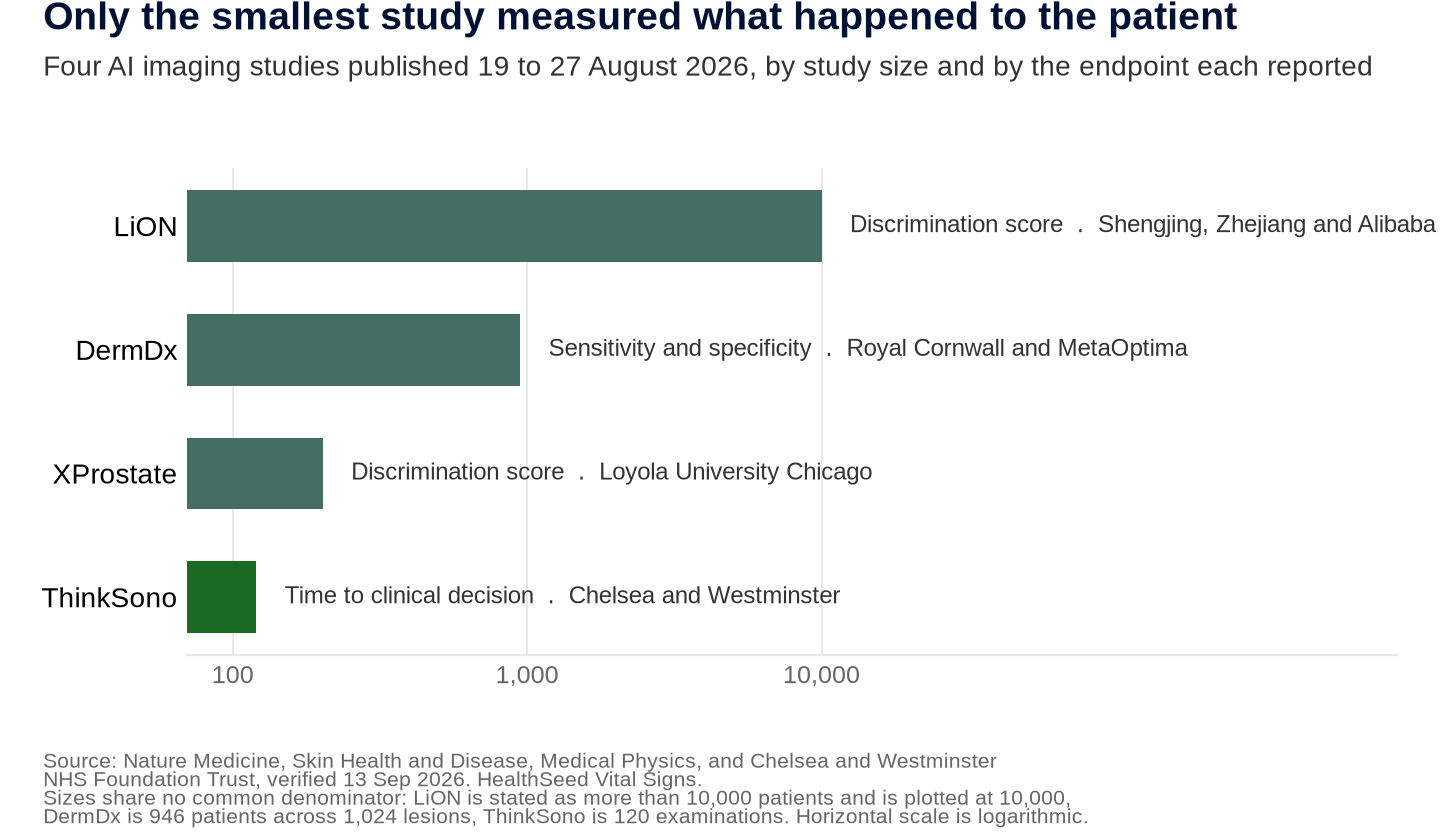
Royal Cornwall Hospitals Trust and MetaOptima reported that DermDx found 296 of 298 confirmed cancers, a sensitivity of 99.3%, across 1,024 lesions on the NHS suspected skin-cancer pathway. Sensitivity across malignant and premalignant lesions together was 98.1%, and specificity was 57.6%, which is how often it correctly leaves alone people who do not have the condition (Skin Health and Disease, 27 August 2026). The images were collected as patients came through the clinic, then analysed afterwards and blinded. The software never influenced anyone's care.
Radiologists at Loyola University Chicago tested Siemens Healthineers' XProstate research prototype on 202 patients against their own reading. The software scored 0.76 for separating cancer from benign tissue and the radiologists 0.73, on a scale where 0.5 is a coin toss and 1.0 is perfect. The gap of 0.03 is not statistically significant, and the authors report a p-value of 0.38 (Medical Physics, 21 August 2026).
Only Chelsea and Westminster measured what happened to the patient. Over a three-month pilot the trust's AI-supported handheld ultrasound pathway for suspected blood clots in the leg produced 120 examinations and ruled out clots in 97 of them. It discharged 80% of patients after a single scan. The typical time to a clinical decision was under 30 minutes. For patients needing further investigation, the average wait from first presentation to diagnosis fell from 19 hours to 9 (Chelsea and Westminster, 26 August 2026). None of those numbers describes the model, and all of them describe the service around it.
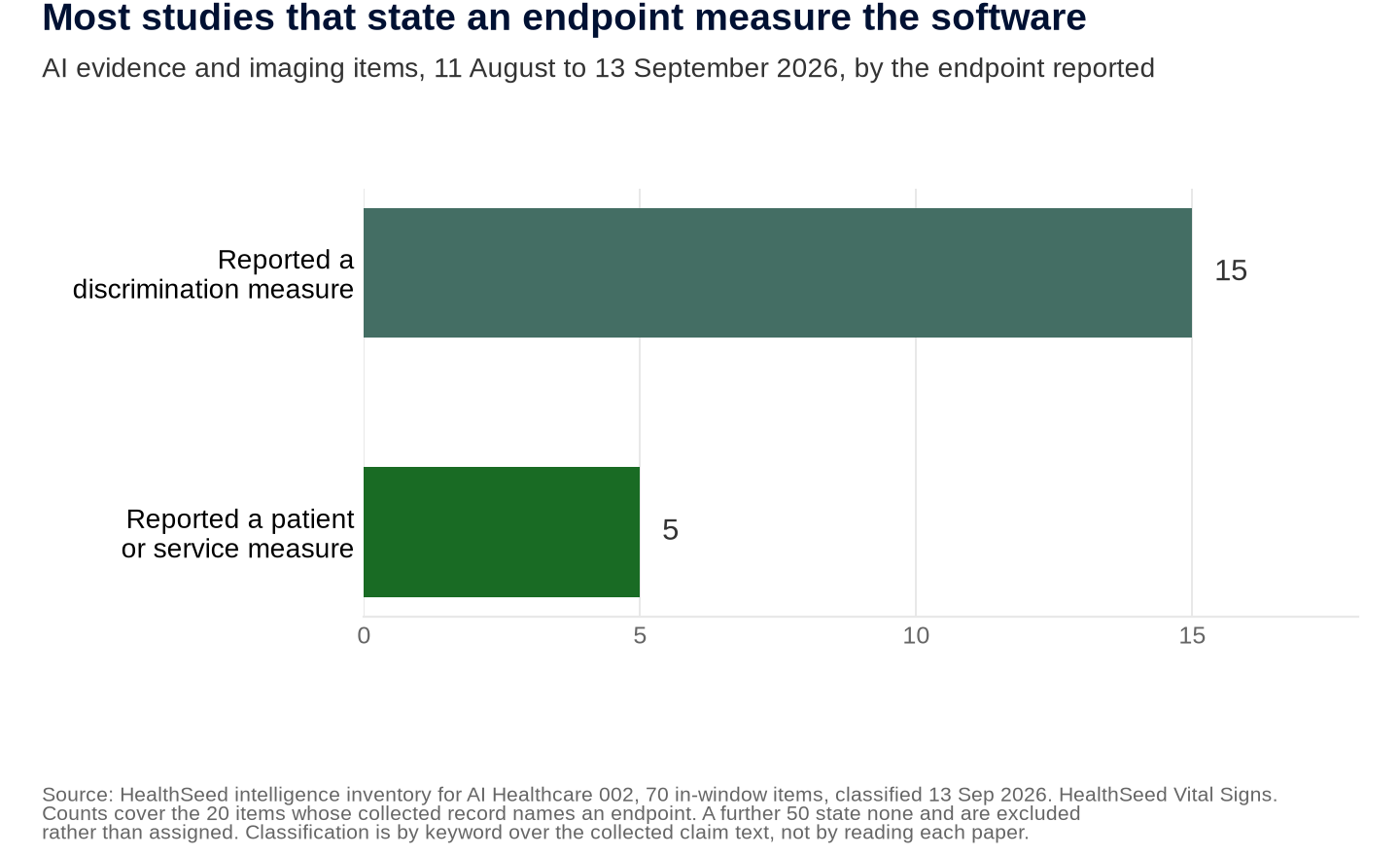
Applies to you if: you are building the evidence plan for a diagnostic or triage product and the primary endpoint is currently a discrimination statistic.
Documentation
Three health systems moved software that listens to appointments and writes the notes from trial into everyday use inside four weeks, and one of the efficiency figures being used to justify that shift turns out to have come from the vendor rather than from the health service that ran the trial. Deployment is running ahead of the evidence underneath it, and the exposure sits with whoever signed the contract as much as with the vendor. Anyone buying or selling this software should get an accuracy monitoring clause into the contract before the next site goes live.
Cleveland Clinic and two NHS trusts moved AI note-taking into everyday use. Cleveland Clinic published its account of deploying Ambience to more than 4,000 clinicians, reporting 70% use at the level of the individual appointment among established users, and 60% agreeing that the tool had increased their likelihood of remaining in practice (npj Health Systems, 11 August 2026). Royal Wolverhampton and Walsall selected Heidi Health after an eight-month pilot, rolling it out across the emergency department, medical same-day emergency care, dermatology, ENT and audiology, and obstetrics and gynaecology (Walsall Healthcare, 25 August 2026).
Metro South's headline saving came from the vendor, not from its trial. Metro South Health in Queensland announced a service-wide rollout of the same vendor's system, reporting that 92% of participating clinicians spent less time on administration. The figure of 59 minutes saved per clinician per day has been widely repeated as a Metro South finding. The outlet that first reported it has since corrected the record, saying the figure came from Heidi Health's own research and was not a finding of the health service's trial (MobiHealthNews). The 92% did come from the trial, which covered 70 clinicians in 2025.
Wisconsin researchers found only moderate patient trust in the tools being deployed. Patients are reaching the question before the industry has settled it. A study of patient acceptability and trust from the University of Wisconsin-Madison reports that 60% of those surveyed held only moderate trust in these tools. The article is behind a paywall. That figure comes from the collected pack and not from the paper itself (Applied Clinical Informatics, 26 August 2026).
| Date | Who | What it did |
|---|---|---|
| 11 August | LCMC Health and Qualified Health | LCMC Health announced that it will implement Qualified Health’s shared generative-AI platform across its entire system, explicitly moving beyond smaller, piecemeal pilots. No completed operational outcome was published; the announcement describes intended benefits including reduced administrative burden, care-gap closure, and improved outcomes. Care-gap identification, clinical and operational workflow support, revenue-cycle automation, and development and monitoring of governed AI agents. (vendor: Qualified Health; scale in named units: 8 hospitals; 15,000 clinicians and staff.) Source |
| 11 August | Vivos Therapeutics, Inc. | Vivos began implementing Greenway Health’s Novare platform at Sleep Centers of Nevada, covering ambient AI clinical documentation and automation across clinical, revenue-cycle, and patient-engagement workflows, with further deployments planned in Arizona and Florida. Source |
| 11 August | Cleveland Clinic | Cleveland Clinic published a peer-reviewed npj Health Systems article describing its health-system and industry partnership for enterprise deployment of ambient AI scribes, covering governance, training, support, and continuous learning. Source |
| 11 August | Cleveland Clinic | A peer-reviewed Cleveland Clinic report published online described the health system-vendor model used to deploy the ambient AI scribe at enterprise scale. The report documented onboarding of more than 4,000 ambulatory clinicians in four months; Cleveland Clinic’s reported implementation results included quicker chart closure and a reduction of approximately 14 minutes per clinician per day in note-writing and review time. Ambient clinical documentation: recording clinician and patient conversations and generating draft structured notes for review in Epic (vendor: Ambience Healthcare; scale in named units: More than 4,000 ambulatory clinicians onboarded across the US enterprise in four months) Source |
| 12 August | PointClickCare | PointClickCare launched limited availability of Vox Advantage, an ambient, voice-enabled documentation solution natively integrated into its senior-care EHR; commercial availability is planned for October 2026. Source |
| 12 August | Suvi Health | Launched an ambient AI care-coordination platform that listens to hospital-care conversations and turns them into shared understanding and actionable continuity for patients, families, and care teams. Source |
| 12 August | Suvi Health | 1842 Studio and Alloy Partners announced the launch of Suvi Health, a new AI healthcare company developed with Mayo Clinic and the University of Notre Dame. Ambient-AI software that captures bedside conversations and turns them into shared summaries, transcripts, and care-coordination tasks for patients, families, and hospital teams. Source |
| 13 August | athenahealth | athenahealth made its AI-native athenaOne experiences, including the athenaAmbient ambient documentation solution, broadly available to 170,000 clinicians, a figure published by athenahealth. Source |
| 13 August | athenahealth | athenahealth announced broad availability of its AI-native athenaOne experience, including the embedded athenaAmbient scribe, and reported that one customer reduced chart-preparation and documentation time by nearly six minutes per visit while exceeding 80% same-day chart completion. Source |
| 17 August | Cerbo | Cerbo announced the launch of AI Scribe, an ambient documentation product embedded directly in its EHR that records patient encounters with consent and drafts structured notes for clinician review. Source |
| 17 August | Hertfordshire Community NHS Trust | The Trust announced that it was trialling an AI ambient scribe that listens during consultations and automatically drafts clinical notes, with patient consent and stated NHS data-security controls. Source |
| 17 August | Evaxion A/S and Duke University School of Medicine | Evaxion announced EVX-05, an off-the-shelf therapeutic glioblastoma vaccine programme directed at AI-identified conserved ERV antigens. Evaxion said its AI-Immunology platform identified ERV-derived antigens shared between glioblastoma patients; the announcement describes the target-selection basis but does not report new clinical or in-vivo validation data. (target: Conserved endogenous-retrovirus-derived tumour antigens; indication: Glioblastoma) Source |
| 18 August | PhyxUp Health | PhyxUp AI is an ambient-AI product for physical-therapy practices that records and summarises visits, creates EMR-ready notes and personalised home-exercise and remote-therapy-monitoring programmes, and prepares related documentation and claims. Source |
| 19 August | Summa Health, Ohio | Summa Health published goals of more affordable, accessible and resilient care, smoother operations, reduced administrative burden, and improved patient, provider and staff experience, but reported no measured operational outcome; the announcement describes the programme as in progress and planned rather than fully live. Enterprise AI transformation spanning diagnostic support, supply-chain and clinical/financial operations, ambient documentation, coding and revenue-cycle automation, virtual primary care, patient engagement, care coordination, claims administration, care navigation, and post-acute care; Percepta is building an AI-enabled Health System Command Center to orchestrate these functions. (vendor: Aidoc; Clarium; Commure; Fabric; HippocraticAI; Judi Health; Transcarent; Verse Medical; Percepta; scale in named units: Summa Health and SummaCare, representing approximately 8,000 employees according to Summa Health; the system includes hospitals, community medical centers, a health plan, an accountable care organisation, a multispecialty physician organisation, and medical education and research, but no hospital, site, or clinician count was published.) Source |
| 19 August | Matic | Matic announced its evolution from an ambient scribe into an AI-native clinical-intelligence ecosystem spanning patients, practices and physicians. Provides an AI-native clinical-intelligence platform connecting documentation, coding, evidence, inbox management, follow-up and care coordination. Source |
| 21 August | Penn Medicine | Penn Medicine’s updated patient guidance confirmed the use of consent-based ambient documentation, in which an AI scribe listens to visits and prepares a chart note for care-team review and approval. Source |
| 23 August | Cleveland Clinic Foundation | An in-window report highlighted Cleveland Clinic’s published account of deploying Ambience’s ambient AI scribe to more than 4,000 clinicians, with the Cleveland Clinic Foundation reporting 70% encounter-level utilisation among established users after one year and 60% saying the tool increased their likelihood of remaining in practice. Source |
| 24 August | DeepCura | DeepCura announced the Electronic Health Workforce, a clinician-supervised workflow-automation product combining ambient documentation with AI receptionist, intake, scheduling, inbox, and billing functions; the dated announcement was found only through syndicated press-release distribution, so this item is UNCITED. Source |
| 24 August | FDB (First Databank) and Tebra | FDB announced the first commercial deployment of Script Agent with Tebra, converting ambient patient-visit dialogue into structured prescriptions for clinician review within Tebra’s AI documentation workflow. Source |
| 24 August | LUVN and Tandem Health | LUVN selected Tandem Health’s AI assistant for what Tandem described as Finland’s largest rollout, expanding ambient clinical documentation in a European healthcare setting. Source |
| 25 August | NHS clinicians get more consultation time through ambient voice documentation | Royal Wolverhampton and Walsall NHS trusts are rolling out Heidi Health’s ambient voice technology after an eight-month pilot across emergency medicine, same-day emergency care, dermatology, ENT, audiology, and women’s health. The system listens securely to consultations, creates structured notes, and leaves the clinician to review and approve the record. Dr Jamil Aslam, an emergency medicine consultant who led the pilot, said the technology had “released tens of thousands of hours back to frontline teams”. Average documentation time fell to less than four minutes per patient, giving clinician Source |
| 25 August | Suki | Suki launched Suki Dictation as a standalone AI documentation product, available independently or alongside its ambient documentation system and built natively into Epic and MEDITECH. Source |
| 25 August | American Academy of Orthopaedic Surgeons (AAOS) | AAOS Now published an article on ambient AI scribes, citing evidence including a JAMA Network Open study in which burnout fell from 51.9% to 38.8% after 30 days; JAMA Network Open published that figure, not AAOS. Source |
| 25 August | Aiforia Technologies Plc and Stratipath | Aiforia and Stratipath announced that Stratipath Breast would be integrated into the Aiforia Clinical Platform so laboratories could access both companies’ breast-cancer AI applications through one workflow. The companies’ announcement describes the tools as validated, but provides no underlying study, registration or regulatory decision in the announcement; this evidence is therefore limited to the announced commercial integration. (modality: Digital pathology, breast-cancer diagnostic and prognostic analysis) Source |
| 26 August | University of Wisconsin-Madison and UW Health | A US mixed-methods study published in Applied Clinical Informatics found that 60% of surveyed patients had moderate trust in ambient AI scribes, with acceptability generally supported by perceived benefits, low patient burden and limited ethical concerns; patients recommended advance notice and education. Source |
| 28 August | Penn Highlands Healthcare and Doximity | Penn Highlands Healthcare announced a system-wide partnership with Doximity covering Dialer, Ask, and Scribe; Doximity Scribe generates notes and transcripts from in-person and virtual visits to reduce documentation burden and support more clinician and patient face time. Source |
| 28 August | Penn Highlands Healthcare and Doximity | Penn Highlands Healthcare announced adoption of Doximity’s clinical AI suite, including Doximity Scribe, an ambient documentation assistant, across its nine-hospital system to reduce clinicians’ documentation and communication workload. Source |
| 28 August | Doximity; Penn Highlands Healthcare | Doximity announced that Penn Highlands Healthcare would deploy Doximity Dialer, Ask, and the ambient documentation tool Scribe across its nine hospitals. Source |
| 31 August | Hertfordshire Community NHS Trust (UK) | The trust reported that its six-month pilot produced more than 13,000 consultation notes and over 2,000 letters, with 150 clinicians using the system by the end of the pilot. Ambient Voice Technology transcribes consultations and generates draft clinical notes, summaries, and letters for clinician review across community and mental-health services (vendor: Accurx; scale in named units: More than 1,000 clinicians under a three-year contract; estimated support for 250,000 appointments annually) Source |
| 3 September | Commure Ambient AI becomes commercially available across Europe | Commure announced on 3 September that Ambient AI had been CE marked as Class I medical-device software under the EU MDR. The system drafts clinical documentation from the consultation, allowing clinicians to review and sign a note instead of creating the first draft manually. Its classification reflects that it supports documentation and does not make diagnostic or treatment decisions, and the company says the product is now commercially available across Europe and the UK. READ: Clinical teams can now adopt ambient documentation software under an EU medical-device framework, which may make dep Source |
| 3 September | Metro South Health | Metro South Health announced a health-service-wide rollout of Heidi’s ambient AI scribe after a 2025 trial; Metro South Health reported that doctors saved an average of 59 minutes per day and that 92% of participating clinicians spent less time on administration. Source |
| 8 September | Dove Press / Journal of Healthcare Leadership | Published a review proposing a governance, training, workflow-redesign, consent, monitoring, and quality-assurance framework for hospital deployment of ambient AI scribes. Source |
| 9 September | Avo and MEDITECH | Avo announced that Chart Assist, Ask Avo, and AI Scribe had joined the MEDITECH Alliance, extending AI-supported chart review, clinical decision support, ambient documentation, and workflow automation across MEDITECH Expanse. Source |
| 9 September | Nivaran, formerly ScribeEMR | Nivaran announced its rebrand and described a combined healthcare workflow offering comprising AI scribing, AI-plus-human note review, live remote scribing, coding, revenue-cycle management, and virtual medical-office services. Source |
Applies to you if: you are selling documentation AI into a health system, or buying it, and the contract has no accuracy monitoring clause.
Capability and deployment
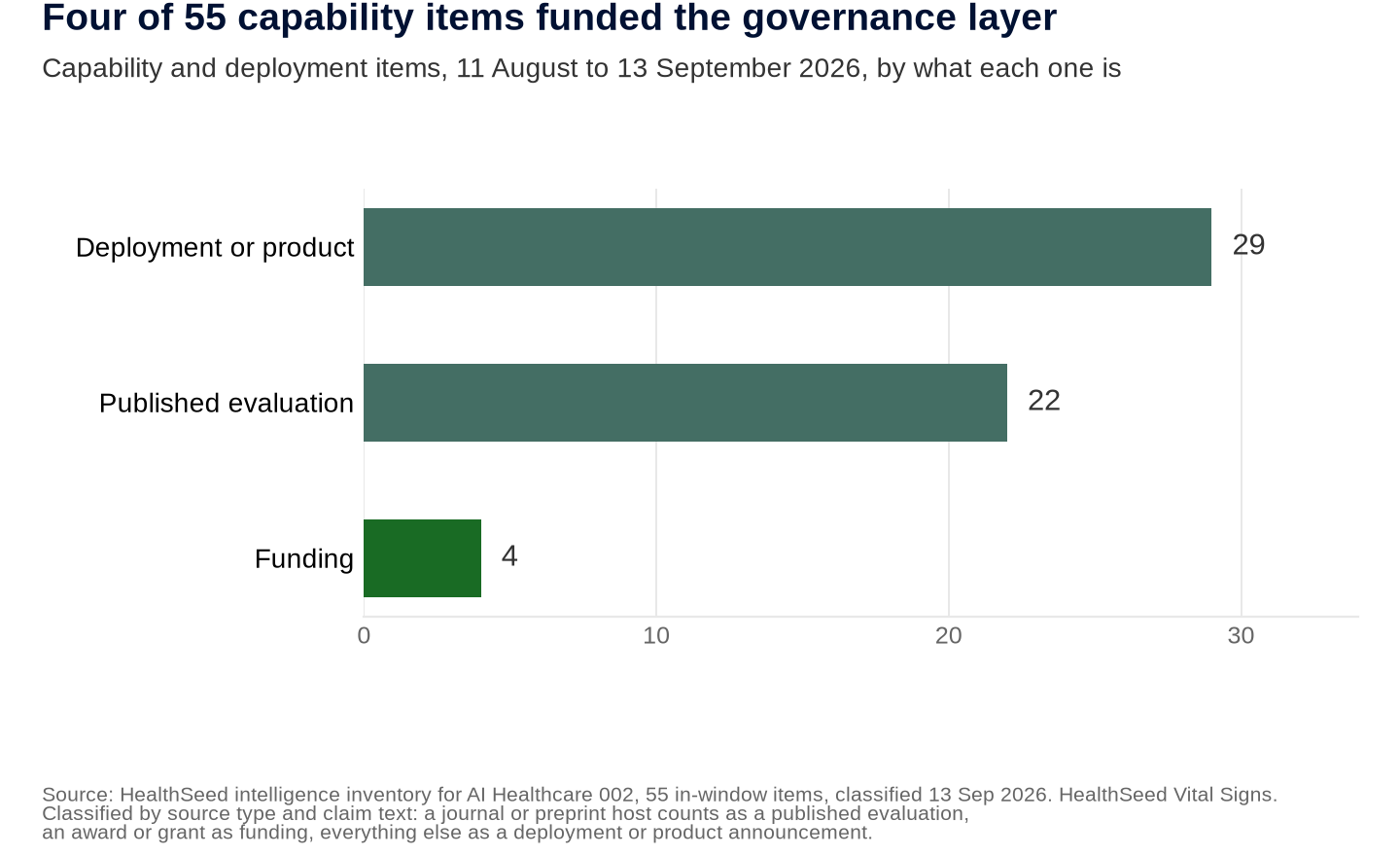
Two federal awards, two published evaluations and one European surgical rollout landed inside three weeks, and together they circle the same question: what a clinical AI system does when it should not answer. The money is going into architectures that keep clinical authority outside the model, while the evaluations found that models do not reliably decline in the places they are most likely to be wrong. A company building an agentic product should be able to say in one sentence where its clinical authority sits.
ARPA-H put $16.7 million behind keeping clinical authority outside the model. On 9 September ARPA-H made two awards under its ADVOCATE programme, up to $9 million to UpDoc and up to $7.7 million to Atman Health, both for agentic cardiovascular care. UpDoc's record describes "a clinical AI agentic system whose conversational intelligence is separated from clinical authority by a clinician-built rules system that validates every proposed action against approved protocols before execution" (ARPA-H, 9 September 2026). Atman Health's is built on an evidence-based clinical decision engine behind a voice-first interface (ARPA-H, 9 September 2026).
Two evaluations found models declining in the wrong places. The Journal of Managed Care and Specialty Pharmacy tested five models against 250 clinician-curated medication lists, each holding one clinically relevant interacting pair. Accuracy ran from 54.1% to 83.7%. The finding that matters sits elsewhere: alignment between a model's refusal behaviour and its likelihood of error was weak to moderate, and prompting for caution did not reliably recalibrate it (JMCP, 2026;32(9):1076). Beth Israel Deaconess released mental-health subsets of HealthBench on 25 August, 610 conversations screened from 5,000 and validated through two rounds of blinded clinician review, reporting a statistically tied frontier cluster and measurable refusal behaviour in two of twenty models (arXiv, 25 August 2026).
Medtronic ran AI-planned spine surgery at seven European sites. On 10 September Medtronic reported more than 23 procedures with its Stealth AXiS system across seven sites in Germany, the United Kingdom, Italy and Spain, combining "AI-driven surgical planning, real-time navigation and robotic-assisted execution" (Medtronic, 10 September 2026). The Saudi Food and Drug Authority separately authorised Dental IQ and SAARIA, the first Saudi-developed AI medical software products of their kind (SFDA, 10 September 2026).
Applies to you if: you are building or buying an agentic clinical product and cannot yet say, in one sentence, where its clinical authority sits.
The argument
Five institutions acted this cycle, and each asked for the same thing in a different language. The FDA approved software that its maker may keep changing, so the approval now depends on what the company does after launch. The MHRA's commission put it more plainly still, asking for approval in stages and a public register showing how a tool performs once it is in use. Medicare ruled that a device sat outside the category it may pay for at all, which is a question no clearance answers. Health systems buying documentation software want to know it still works in their own building. Patients want to be told it is being used at all.
A well-informed reader could object that this is ordinary institutional behaviour, and that it was ordinary before this cycle opened. The objection is fair, and each event is unremarkable on its own. What changed is that the evidence these institutions want has become specific enough to design a study around, and expensive enough that designing for it late means paying for the work twice.
What follows for an operator is narrow, and it is not a strategy. Two questions belong on next week's agenda. Which benefit category does the product fall into, and who would sponsor a billing code for it? Who owns the performance data after launch, by name, with time in their week for it? A clearance answers neither, and both answers cost more the longer they wait.
About HealthSeed
HealthSeed is a Swiss healthcare venture studio and commercialisation partner. We work alongside biotech, medtech, diagnostics, digital health, and AI companies as they enter and scale across Europe, the United States, and the Middle East and North Africa, backed by an Expert Community of more than 35 specialists and a network of partners who have run the functions they advise on. We also build ventures and AI products of our own, so we read this market as participants. Vital Signs is where we publish what we are reading and what we think it means, with a primary source behind every claim.
HealthSeed AG, Weidmannstrasse 5, 8046 Zürich, Switzerland. CH-020.3.056.106-6. contact@healthseed.vc