
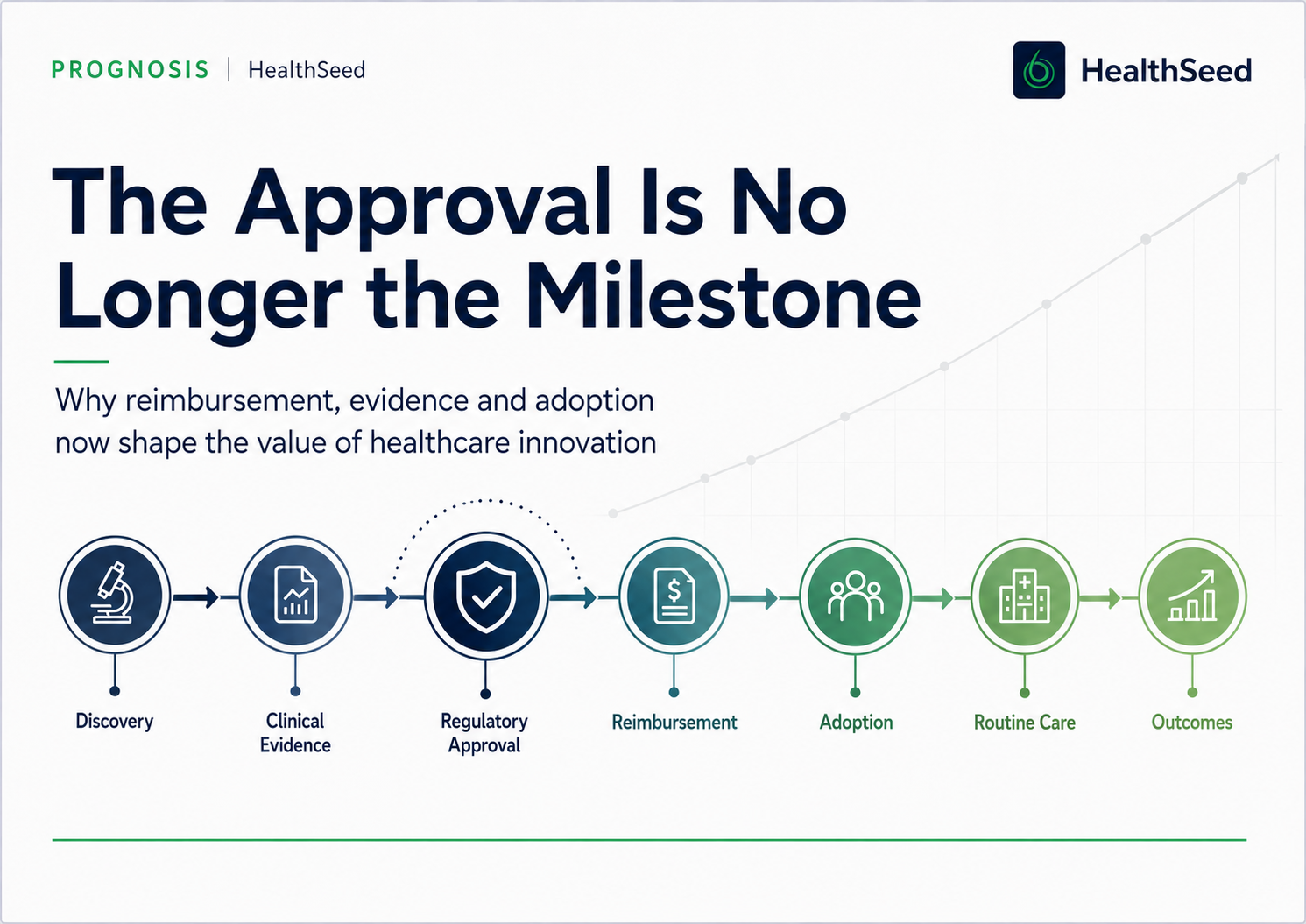
The Approval Is No Longer the Milestone
Why reimbursement, evidence and adoption now shape the value of healthcare innovation.

Editorial note
Welcome to the first edition of PROGNOSIS, the monthly opinion paper from HealthSeed.
Our Vital Signs newsletters already track what is moving across MedTech, HealthTech, AI Healthcare, AI Drug Discovery and BioTech. They tell you what happened, what it means for your sector and what to do about it. They will continue to do exactly that.
PROGNOSIS has a different purpose.
Once a month we step back from the individual tracks and take a position on the forces running underneath all of them. Where Vital Signs reports, PROGNOSIS argues. Where Vital Signs stays inside a sector, PROGNOSIS looks for the pattern that becomes visible when you read biotech, medtech, diagnostics, digital health and the systems that fund and deliver care alongside each other.
Our perspective comes from working across those different parts of healthcare, and from a shared conviction that innovation creates value when people can actually benefit from it.
This first issue starts with a problem the two of us keep meeting from different directions.
Healthcare’s innovation machinery has moved faster than its adoption machinery.
For founders, investors and health systems, closing that gap may be one of the defining commercial opportunities of the next decade.
Daren Wilson and Safia Agueni
Co-Founders and Senior Partners, HealthSeed AG
Our view
Regulatory approval remains one of the most important milestones in healthcare. It establishes safety, effectiveness and permission to enter a market.
Commercial success now depends on a much wider set of conditions.
A product needs a route to reimbursement. The evidence has to answer the questions that matter to payers and providers. Customers have to be ready to adopt it. Clinical workflows and data infrastructure have to accommodate it. Policy and stakeholder environments can determine how quickly a new category becomes accepted.
This means commercialisation increasingly starts years before launch.
At the same time, many of the technologies capable of moving healthcare towards earlier intervention and prevention are reaching the market faster than the financing models designed to pay for them.
We see both problems converging.
The companies that understand this early will design evidence, reimbursement and adoption alongside the product. Healthcare systems that understand it will begin rewarding outcomes and earlier intervention, loosening the grip of payment structures built around episodes of illness.
There are encouraging signs that both are beginning to happen.
Regulatory approval is only the first access gate
In pharmaceuticals, nobody who has lived through a major launch mistakes regulatory approval for commercial success.
Approval matters enormously. Then another process begins, and it can be the longer one.
Payers assess value. Health technology assessment bodies examine comparative evidence. Formularies and treatment pathways influence access. Budgets have to be found. Physicians need to understand where a product belongs in practice. Patient organisations can change awareness of unmet need and influence the policy environment around it.
A medicine can be approved and still take years to reach all the patients it was developed for.
Much of the newer healthcare innovation market is now discovering the same reality.
A medtech company can receive FDA clearance while facing a long hospital procurement cycle. A digital health company can demonstrate clinical utility without having an obvious reimbursement mechanism. An AI company can produce a convincing pilot and then discover that the health system cannot integrate the product into its workflows, data architecture or operating budget.
What is interesting now is that regulators and payers are starting to acknowledge the problem.
The United States provides one of the clearest examples.
CMS and the FDA announced the Regulatory Alignment for Predictable and Immediate Device, or RAPID, coverage pathway for eligible Breakthrough Devices. The central idea is unusually important: CMS becomes involved earlier in development so that evidence generated for FDA review can also support a future Medicare coverage decision.
For eligible devices, CMS intends to issue a proposed national coverage determination on the same day as FDA market authorisation. The agencies say the approach could reduce the period between authorisation and Medicare national coverage from roughly a year or more to as little as two months in some cases. The pathway also requires eligible studies to include Medicare beneficiaries and clinical outcomes agreed with both FDA and CMS. 1
That last point deserves more attention than the faster timetable.
RAPID effectively tells device companies to think about regulatory evidence and payer evidence together while the product is still being developed.
That is a significant change in commercial logic.
The FDA and CMS Innovation Center are testing a related idea through the Technology-Enabled Meaningful Patient Outcomes, or TEMPO, pilot and the ACCESS payment model.
ACCESS gives Medicare a mechanism to pay organisations delivering technology-supported chronic care according to measurable outcomes instead of a prescribed list of activities. It initially covers conditions including hypertension, diabetes, chronic musculoskeletal pain, depression and anxiety. CMS explicitly describes the problem it is trying to solve: payment has struggled to accommodate modern technology-supported care. 2
Cadence’s HypertensionOS is one of the digital technologies entering the TEMPO pilot. FDA makes clear that participation is neither approval nor clearance, and that enforcement discretion within the pilot does not constitute a determination of safety or effectiveness. The significance lies elsewhere. Product evaluation, real-world use and a payment model are being brought into the same experiment. 3
Europe is arriving at related questions through its own, more fragmented systems.
The Dutch Healthcare Authority’s 2026 digital-care guidance explains that a digital application will generally need to be financed through the care it supports, with no separately billable line for the software itself. Providers and insurers retain considerable room to agree how digital care creates value within existing pathways. 4
NHS procurement increasingly asks digital-health suppliers to arrive with evidence spanning clinical safety, data protection, technical security, interoperability, usability and accessibility.
Germany has multiple possible reimbursement routes depending on whether a technology sits within physician services, hospital care, DiGA, new treatment methods or local procurement. Italy is still working through how digital therapeutics should enter publicly funded care.
The systems are different.
The commercial message coming back is the same.
Regulatory access opens the door. The market still has to be created.
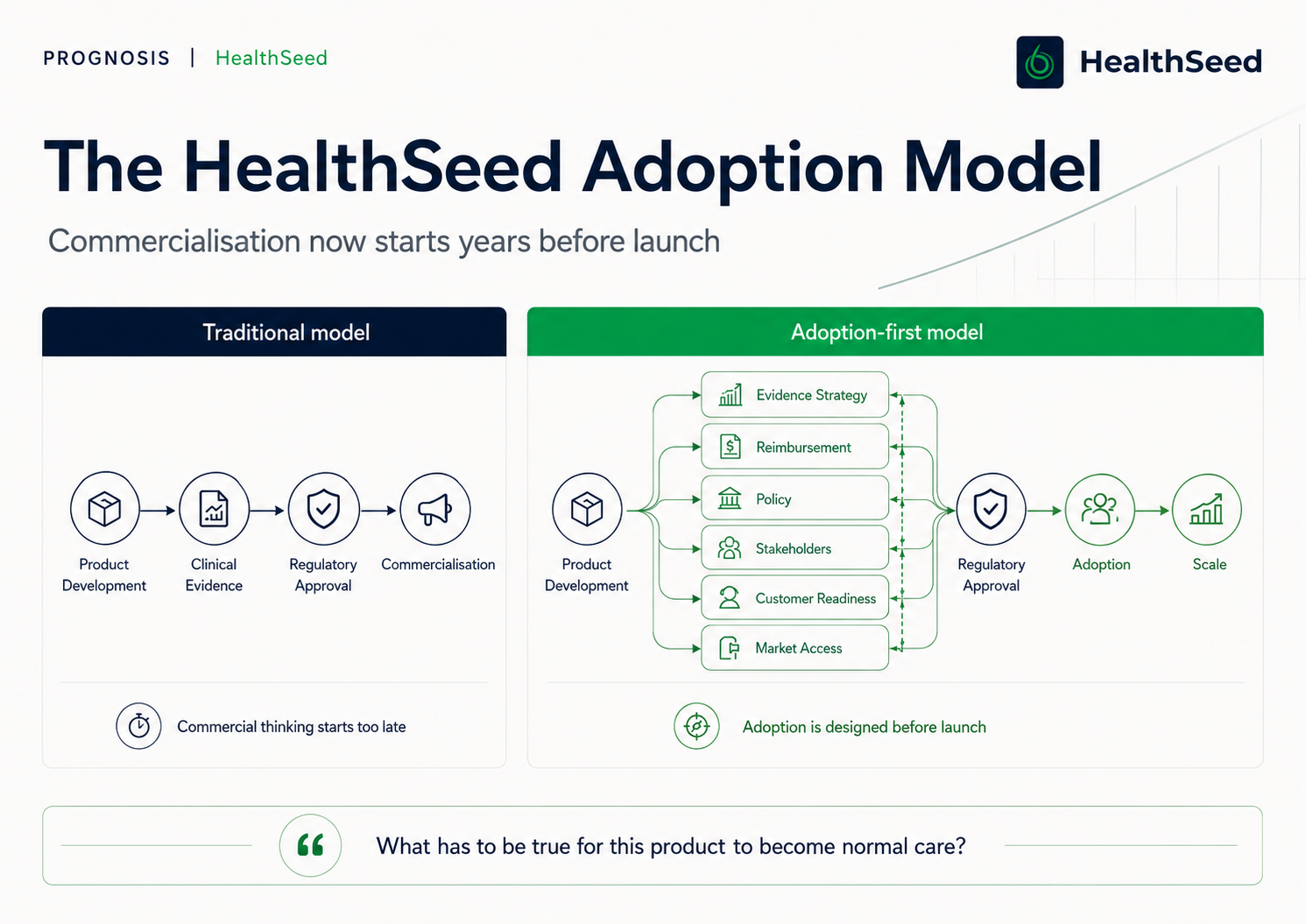
Commercialisation now starts years before launch
This changes how healthcare companies need to be built.
Many science-led companies still develop in sequence.
Develop the technology. Generate the clinical evidence. Obtain regulatory approval. Raise another round. Then begin thinking seriously about reimbursement, market access and commercialisation.
That sequence carries increasing risk.
For products entering complex healthcare systems, commercial strategy has to influence development well before launch.
A company needs to understand who will pay, what that stakeholder values, what evidence will be required and where the economic benefit of adoption actually appears.
Those questions influence clinical development.
A payer may care about hospitalisation avoided. A hospital may care about capacity released. A physician may care about diagnostic confidence or time. A patient may care about convenience, quality of life or avoiding an invasive procedure.
The product can be identical while the definition of value changes depending on who is being asked to adopt it.
The stakeholder environment matters too.
Physicians can determine whether a new technology becomes clinically credible. Patient organisations can expose unmet needs that conventional market research misses. Procurement teams often identify implementation barriers that never appeared in a clinical study. Policymakers can create, narrow or remove the routes through which an innovation reaches patients.
These relationships take time.
Pharmaceutical companies learned this through decades of launch experience, often painfully. Many younger medtech, diagnostic and healthtech companies are now having to develop comparable capabilities far earlier in their lives and with much less capital.
For founders, we think one question is particularly useful:
What has to be true for this product to become normal care?
That question reaches much further than approval.
It can change clinical endpoints, study locations, evidence strategy, stakeholder engagement, market sequencing and capital requirements. It can also reveal very early that the first intended market is the wrong one.
This work affects strategic autonomy.
Large corporate partnerships will remain an important route to market, especially where distribution infrastructure or specialised capabilities create genuine advantage. The better prepared a start-up is, the more deliberate that partnership can become.
A company that already understands its reimbursement logic, stakeholder environment and route to adoption enters a transaction from a position of knowledge.
Strategic autonomy gets built long before a term sheet appears.
Healthcare wants prevention. Its spending still tells another story
The adoption problem becomes even more obvious when innovation moves upstream.
Healthcare systems increasingly say they want earlier intervention, healthier populations and less pressure on hospitals.
The spending numbers show how far there is to travel.
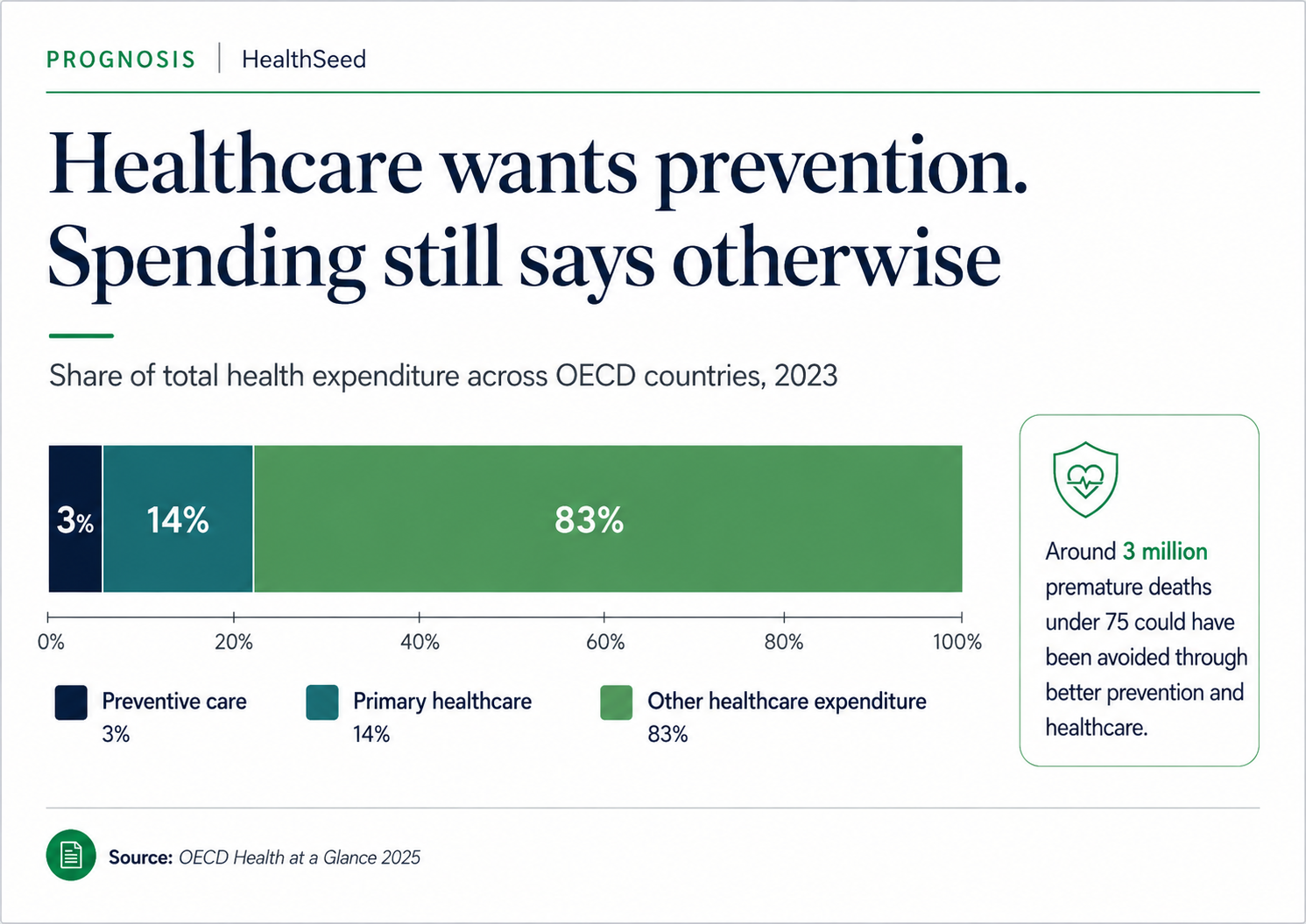
The OECD’s latest comparable data show that preventive care accounted for only 3% of total health expenditure across OECD countries in 2023. Primary healthcare accounted for another 14%. Both shares were broadly similar to a decade earlier once the temporary increase in prevention spending during the pandemic had receded. 5
At the same time, the OECD estimates that around three million premature deaths among people under 75 could have been avoided through better prevention and healthcare. 6
We should be careful with the economics here.
Preventive healthcare does not automatically save money. Some preventive interventions are cost-saving, many are highly cost-effective, and others add cost while generating health benefits that societies decide are worth paying for.
The important point is that healthcare systems remain heavily weighted towards responding once illness has become visible.
Innovation is increasingly giving us opportunities to act earlier.
Freenome’s investigational SimpleScreen Lung test received FDA Breakthrough Device Designation this month. It is being developed for high-risk adults who are currently outside guideline-recommended lung cancer screening. Freenome cites CDC data indicating that only around 18% of Americans for whom lung cancer screening is recommended actually receive it. The test is still investigational, and Breakthrough Device Designation is a development milestone and not permission to market. The problem it is trying to solve is already very real: eligible people are not reaching an existing preventive pathway. 7
Abbott and Google Health are approaching prevention from another direction. Their new partnership links ongoing glucose information from Abbott’s Lingo biowearable with the Google Health app and AI-enabled health coaching. The companies are also planning a large real-world metabolic-health study combining glucose, wearable, laboratory and survey data.
Lingo is intended for adults not using insulin and is explicitly not intended to diagnose disease. That distinction matters. The opportunity is to understand whether continuous information can support healthier behaviour before somebody enters conventional chronic-disease management. The evidence for that broader promise still needs to be built. 8
CMS’s ACCESS model is perhaps the more significant signal because it moves the argument into payment. The model gives Medicare a mechanism to fund technology-supported management of common chronic conditions, with full payment tied to measurable improvement. CMS describes the model as supporting disease prevention and health promotion and acknowledges that traditional fee-for-service payment has struggled to accommodate this type of care. 2
This is where our optimism begins.
The economics are slowly being redesigned around what technology can now enable.
There is also an equity dimension that should be part of this discussion from the beginning.
The OECD’s 2025 analysis of gender and health found that women live longer than men across OECD countries while spending more of those years in poor health. It also points to a historical lack of inclusive research and differences in the way women and men experience diagnosis and treatment. 9
That has commercial implications.
When reimbursement systems, clinical evidence and standard care pathways have been built around needs that were historically better recognised, valuable innovation in under-served areas can enter a market where the access pathway is still immature.
Women’s health is an important example.
It should also act as a warning against treating prevention as a single homogeneous category. Earlier intervention has to reflect differences in biology, risk, behaviour and access. Better data and more representative evidence can make prevention more precise and more equitable at the same time.
The opportunity is larger than shifting money from hospitals into prevention.
It is to design a health system capable of recognising value earlier in the patient journey.
Commercial evidence is becoming a commercial asset
This may become one of the most important changes in how healthcare companies are valued.
For years, evidence was often discussed primarily as something required by a regulator.
Companies now need evidence that answers a wider range of questions.
Does the product work in ordinary care?
Which patients benefit?
Does it change a clinical pathway?
Does it release meaningful capacity?
Does it improve an outcome a payer is prepared to reward?
Will the result hold across different populations, institutions and geographies?
The answers increasingly determine reimbursement, procurement and scale.
This month, twelve US health systems formed the Diagnostic AI Consortium with Aidoc. Together the member systems care for nearly 20 million patients annually. The consortium intends to measure the safety, quality and speed of AI-enabled diagnosis across varied sites, populations and equipment, as well as performance drift and bias. Initial results are expected in 2027. Aidoc supplies the technical infrastructure, which means independence and generalisability will need to be assessed carefully when results emerge. 10
The more important signal is the structure of the initiative.
Twelve healthcare systems have concluded that evaluating diagnostic AI at scale requires shared evidence and shared governance.
That is a more mature market.
It suggests that procurement is moving beyond the question of whether an algorithm performs well in validation. Buyers increasingly need evidence that a technology continues to perform inside the complexity of routine clinical care.
Investors should pay attention to the same shift.
AI has made large quantities of information dramatically easier to interrogate. General analytical capability will continue to improve. Features that appear differentiated today can become widely accessible in a surprisingly short period.
That increases the value of assets competitors cannot simply retrieve from the same public corpus.
Longitudinal clinical data.
Well-characterised proprietary datasets.
Real-world outcome evidence.
Validated implementation data across institutions and patient populations.
Relationships that generate new data continuously.
The source of differentiation therefore moves closer to the underlying evidence base and the company’s ability to keep improving it.
Commercial evidence is becoming a commercial asset.
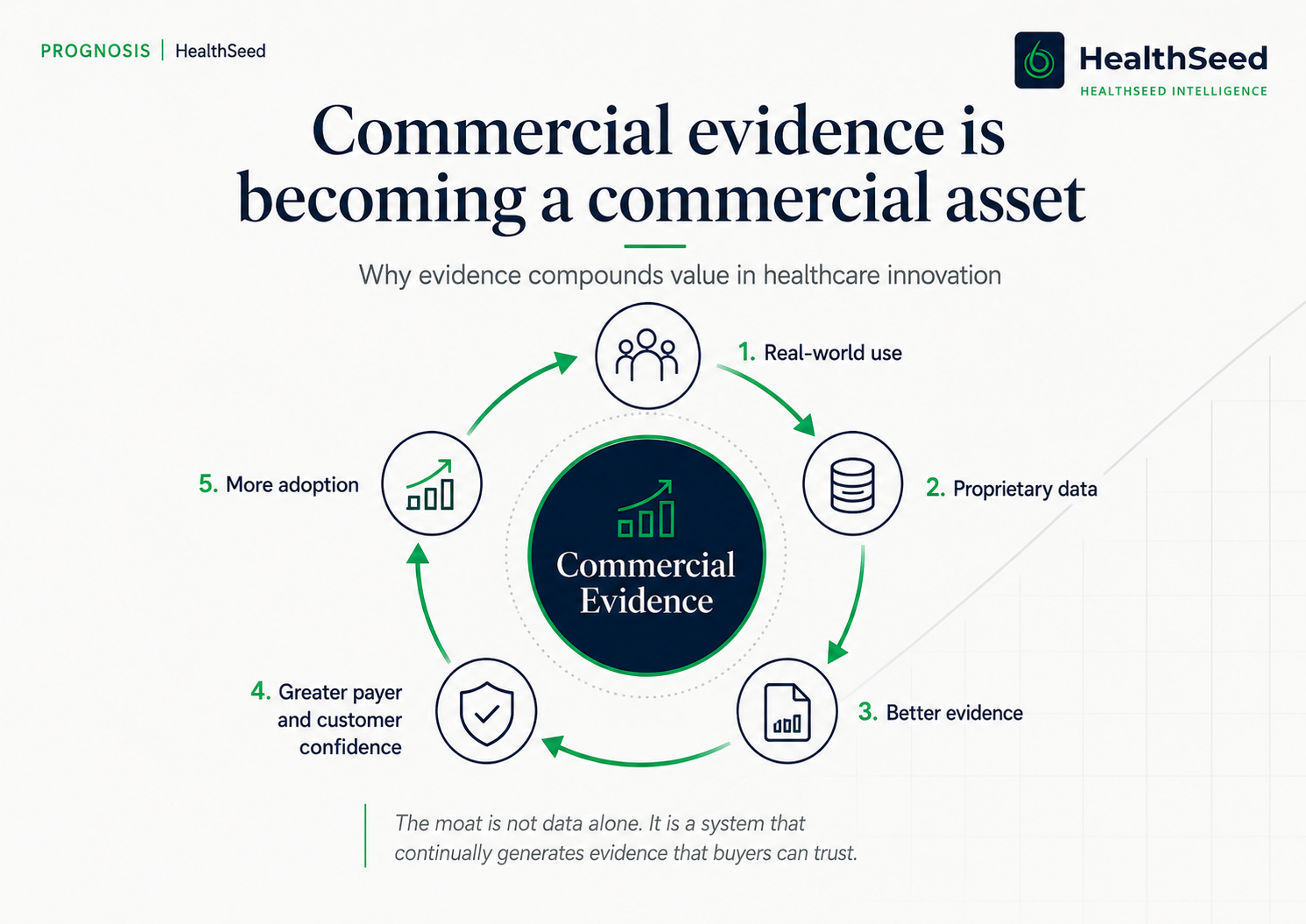
For founders, that changes the lifecycle of evidence generation.
Evidence strategy should continue through launch and adoption. Each stage can answer another commercial question, reduce uncertainty for a payer or buyer and strengthen the company’s understanding of where the product creates the most value.
The regulatory dossier gets a product into the market.
The evidence accumulated around real-world adoption can shape the quality of the business that gets built afterwards.
Healthcare AI is moving from capability to measurable outcomes
Healthcare AI has spent several years attracting extraordinary attention and capital.
That period accelerated experimentation and brought substantial technical talent into the sector. It also created an environment in which the presence of AI sometimes carried more weight than the evidence of value behind it.
We think the market is entering a healthier phase.
Health systems increasingly want to know whether AI releases capacity, improves an outcome, removes avoidable cost or solves a workflow problem that clinicians actually experience.
That is progress.
Ochsner Health and Paradigm Health provide a useful example. Their clinical-trial recruitment programme connects AI-enabled patient identification with Ochsner’s clinical and research workflows. Across a system of 47 hospitals and more than 370 health and urgent care centres, they report a 41% increase in screening capacity, a 3.6-fold increase in patients actively followed and roughly a 75% reduction in patients requiring manual review.
These are organisation-reported results and do not establish that the intervention increased eventual trial enrolment or improved patient outcomes. The form of the evidence is still important. It measures operational capacity in terms a healthcare organisation can use. 11
The Diagnostic AI Consortium reflects the same direction from another angle. Health systems want to know what happens after deployment: whether performance travels, whether drift appears, whether workflow actually improves and whether patient groups benefit consistently.
This is where the next phase of healthcare AI becomes interesting.
The most valuable applications may not always be the most spectacular.
Clinical-trial matching can matter. So can documentation, prior authorisation, scheduling, patient navigation, continuous monitoring and identifying people who should already be receiving treatment.
AI becomes valuable when it disappears into a better care process.
Healthcare has no shortage of extraordinary technology.
It needs far more technology that becomes ordinary enough to use every day.
Scaling innovation requires experienced operators earlier
A second change is happening in the people required to build these businesses.
Scientific and technical capability remain essential. So does clinical expertise.
Companies moving through reimbursement, procurement, policy, clinical adoption and international expansion also need people who have operated inside healthcare systems and understand how decisions get made.
Historically, a young company could rarely afford that depth of experience across every function.
We are seeing the economics of expertise change.
More experienced healthcare leaders are building portfolio careers, advising several companies or contributing on a fractional basis. AI is simultaneously reducing some of the analytical workload around experienced decision-makers.
That combination creates a useful model for healthcare start-ups.
A twenty-person company may not need a twenty-year pharmaceutical executive five days a week. It may need that person when launch sequencing, payer strategy, policy engagement or a major partnership decision is being made.
The same logic applies across medical affairs, market access, diagnostics, regulatory strategy, clinical operations and data.
This matters because commercialisation is becoming more multidisciplinary while young companies remain under pressure to preserve capital.
Companies can increasingly assemble operating capability around the problem they are solving instead of recreating the organisational structure of a large pharmaceutical or medical-device company.
We are testing this model ourselves.
HealthSeed operates with a small core team, an Expert Community of more than 35 specialists and approximately ten Network Partners across biotech, medtech, diagnostics and healthtech. AI acts as a force multiplier across that network. The objective is to bring experience into a company at the point when it can materially improve a decision.
Our view is simple.
Smaller healthcare companies should have access to experienced operators before they are large enough to hire all of them.
That can make better companies. It can also reduce the pressure to surrender commercial control simply because the organisation lacks one specialised capability internally.
Healthcare data infrastructure is finally starting to catch up
The adoption problem cannot be solved company by company.
Data remain fragmented across institutions and care settings. Procurement is frequently local even when the clinical problem is national. The budget that pays for an intervention may sit far away from the part of the healthcare system that captures the eventual saving.
Patients move through healthcare longitudinally.
Much of the infrastructure around them still does not.
There are reasons to be more optimistic here as well.
Europe’s European Health Data Space Regulation entered into force in March 2025. Its implementation will be gradual, with important provisions applying from 2029 and others later, but its direction is consequential.
EHDS is designed to make it easier for individuals to access and share their electronic health information, to enable secure secondary use of health data for research and innovation, and to develop a more interoperable European market for electronic health-record systems. 12
It will not solve European health-data fragmentation quickly.
It does create infrastructure around a principle that innovators have argued for years: useful healthcare data should be capable of following the patient and, under appropriate governance, contributing to research, evidence generation and better care.
That can change the economics of healthcare innovation.
Better interoperability makes real-world evidence easier to generate. Better longitudinal information supports earlier detection. More representative datasets can improve model development and expose performance differences between populations.
The infrastructure itself increasingly becomes part of healthcare innovation.
This is why the debate about AI cannot stay focused solely on the model.
A powerful clinical model placed inside an organisation with fragmented data, weak integration and no adoption capacity may have surprisingly little impact.
A more ordinary technology embedded inside coherent infrastructure can sometimes achieve far more.
Why we are optimistic
It is easy to describe healthcare as resistant to innovation.
We think that diagnosis is becoming less useful.
Look at what is actually changing.
CMS and FDA are trying to align regulatory and coverage evidence earlier for breakthrough devices.
Medicare’s ACCESS model is experimenting with paying for measurable outcomes from technology-supported care.
European reimbursement authorities are giving providers more room to integrate digital technology into existing care pathways.
Health systems are collaborating to establish shared evidence standards for diagnostic AI.
Europe has begun the long process of building an interoperable Health Data Space.
OECD data are making the mismatch between prevention ambitions and healthcare spending harder for policymakers to ignore.
None of these initiatives is complete. Some will work better than others.
Together they suggest that the healthcare system is beginning to confront the adoption problem as a system problem.
That is a meaningful change.
The companies that benefit will still need excellent science and strong technology. They will also need to understand reimbursement, evidence, policy, market development and the realities of implementation.
That is a more demanding environment for founders.
We think it can also produce better companies.
Capital will have more evidence on which to distinguish a deployable healthcare business from an interesting technology. Health systems will have better tools for buying innovation on the basis of value. Founders who understand the full route to adoption will have more choices about how they scale and whom they partner with.
Patients, above all, should have a better chance of seeing useful innovation move beyond the pilot, the publication or the regulatory decision and into everyday care.
A different definition of healthcare innovation
We started HealthSeed because we believe healthcare can move further upstream.
Much of what we call healthcare still begins when somebody becomes a patient.
The next phase can begin earlier.
Better diagnostics can find disease sooner. Continuous information can reveal deterioration before an acute event. Personalised interventions can help people manage risk. AI can help stretched healthcare workforces use their time differently. New therapeutics can address diseases that previously had few options.
Science is making much of this possible.
Commercialisation will determine how much of it reaches people.
That is why approval can no longer be treated as the destination.
For founders, work on evidence, reimbursement, policy and market development increasingly starts years before launch.
For investors, technical differentiation has to be understood alongside a company’s ability to generate evidence and earn adoption.
For healthcare systems, innovation policy has to connect with the way care is funded and delivered.
And if prevention is to become a healthcare priority in practice, financing has to recognise value earlier in the patient journey.
We are more optimistic about this than we were a few years ago because the pieces are beginning to move.
Regulation and reimbursement are starting to converge in places. Outcome-based payment is becoming more practical. Better data infrastructure is being built. Health systems are demanding evidence that reflects real deployment.
There is still a considerable distance between invention and adoption.
That distance is also where some of the most important healthcare innovation of the next decade will happen.
The next breakthrough may already have been invented.
Our task now is to build a healthcare system capable of using it.