
An AI-designed drug reached Phase III. The evidence bar did not move.
Four questions and a one-page evidence map, for the investor or pharma partner deciding what an AI discovery platform is worth before the Phase III reads out.
Insilico Medicine opened a Phase III trial of rentosertib on 7 July 2026, enrolling 320 patients across 47 centres in China. The company says the target was prioritised by its PandaOmics biology engine and the molecule generated by its Chemistry42 platform, and that early discovery took eighteen months with fewer than eighty molecules synthesised and tested. Take those claims at their own valuation and the position is still this: no AI discovery platform has shown that a molecule arrived at this way survives the clinic at a better rate than one arrived at any other way. Four questions separate a company that can be diligenced from one that can only be admired, and none of them is about the model.
We argued in June that the molecule was never the hard part. The eight weeks since have supplied the two data points that test it. Insilico's Phase III is one. The other is Isomorphic Labs, funded at 600 million dollars and built on AlphaFold, whose chief executive told the World Economic Forum in January that first clinical trials were expected by the end of 2026, a year later than the company had previously committed to.
Most platforms cannot say where the model changed the answer
"AI-discovered" covers everything from a novel target nominated by software through to a chemist's molecule passed through a machine-learning filter. Rentosertib is the useful benchmark because Insilico separates the two, naming the biology engine that prioritised TNIK and the generative platform that produced the compound, and publishing the discovery-to-clinic path in Nature Biotechnology where a partner can read it.
Most platforms in the market cannot make that separation on request, and the inability is the finding. Ask for the decision points where a model changed the answer, and for what the team would have done without it. The value of the platform, and whether a competitor can copy it, depends on which of those two things is true.
Reproduction is the cheapest gate and the one most often skipped
A published paper with named academic co-authors and deposited structures is a different asset from an internal deck. Independent synthesis of the compound, and assay results a partner's own research organisation can reproduce, convert a claim into something checkable.
A partner's research team will run this test regardless. The only variable is when. Run early, it costs a month of schedule. Run during a negotiation, a failed reproduction costs the company its position at the table.
98.4 mL is a hypothesis, not an effect
Insilico's Phase IIa reported a mean improvement in forced vital capacity of 98.4 mL at twelve weeks on 60 mg once daily, against a mean decline of 20.3 mL on placebo, published in Nature Medicine in June 2025. A surrogate endpoint in a small early trial is hypothesis-generating by design. A regulator agreed the hypothesis was worth testing, and the Phase III now under way is that test.
Put the question as a distance. What effect size does the registrational endpoint require, how far does the observed signal sit from it, and what happens to the programme if the gap closes only halfway.
A Phase III in China is a European reimbursement question
Rentosertib's Phase III runs at 47 Chinese centres. A company planning a European or US filing on a package generated in a single region carries a regulatory and reimbursement question it has usually not costed. EMA and FDA both accept foreign clinical data, conditionally, and the conditions cover whether the trial population represents the target one, whether the standard of care in the trial setting matches the market, and whether the sites can be inspected.
Payers apply a separate test again. A comparator reflecting Chinese standard of care may not reflect what a German or French assessment body treats as relevant, and that judgement lands years after the protocol was written. The first three questions are answered by the science team. This one is answered by whoever owns the commercial plan, and in most AI-native discovery companies that sits with a founder alongside everything else they carry.
What has not been proven
No AI-discovered molecule has completed Phase III. No published comparison shows AI-derived candidates failing at a lower rate in the clinic. Insilico's own timeline comparison, eighteen months against the two and a half to four years it cites for conventional discovery, comes from the company's own release rather than from an independent study. Isomorphic's slippage of a year is a data point about one company under scrutiny, not about the method.
Anyone selling certainty in either direction is ahead of the evidence.
The one page most companies do not have
Each claim the company makes, the study that supports it, the authority or partner that will accept that study, and the gap between the two. Building it needs no new studies, only the ones already run and an honest column for the gaps.
It changes the negotiation in a specific way. A bridging study nobody budgeted for, a comparator arm that satisfies one authority while failing another, and then a health-economic model asking for data the trial was never designed to collect: each is cheap to design in at the protocol stage and expensive to retrofit afterwards. Naming them early moves programme risk onto the table while it can still be priced, which is where the conversation ends up anyway.
Rentosertib's Phase III will read out, and the answer will either support the discovery method or it will not. Until then the evidence package is the asset under negotiation, and the companies treating it that way are the ones getting better terms.
The panel
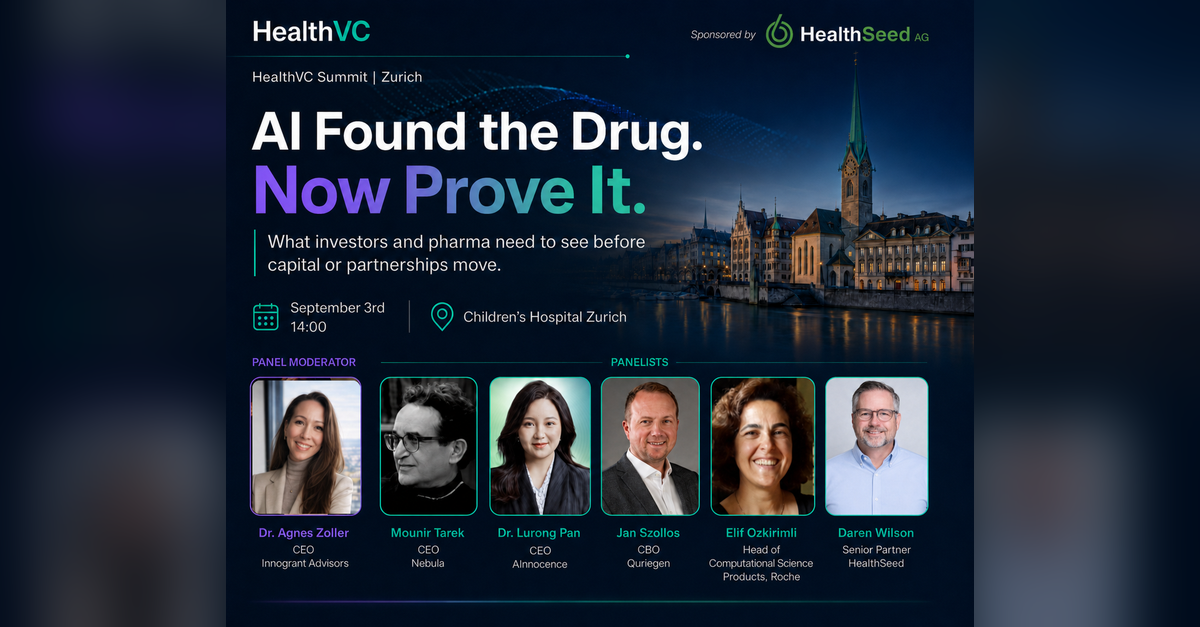
Daren Wilson joined the AI drug discovery panel at the HealthVC Summit in Zurich on 3 September 2026, moderated by Dr Agnes Zoller of Innogrant Advisors, alongside Mounir Tarek of NEBULA, Dr Lurong Pan of Ainnocence, and Jan Szollos of QurieGen. All figures in this article were checked on 22 August 2026.